Faith is out of fashion. The cynical and sarcastic edge of lines and stanzas in so much contemporary poetry has almost become a fatalistic ideology. The total belief in oneself, fueled by a massive New Age industry promoting the notion of being one’s own god, is so prominent as to make an encounter with anything else strange, foreign, and, ironically, subject to ridicule. Surrender, too, to whatever powers may be, cannot be employed, lest the entire fragile mansion of belief in the self, and the self only, should crumble. Rollender knows and understands the spiritual and emotional states of things and consciously writes against that fatalistic imperative with poems that are resplendent in both sorrow and hope, and certainly within the luminous and fraught framework of a hard-won faith.
In “Ways of Blessing,” Rollender writes, “eternity and grief both look like water,” and we know that water means renewal and life source. This poem acts as a sort of archway through which we will enter into poems that often feel as though they exist out of space and time. At once hallucinatory and grounded, “Ways of Blessing” is an initiation into poems that explicate the vagaries of life as woman, mother, daughter, and wife, with the specter of the young girl ever present. The body, in all of its incarnations, is reminiscent of the body of humanity and the Body of Christ, through which the speaker of these poems implores in words that are sometimes reminiscent of gilt-edged dirge and sometimes roughhewn prayer.
We hear the poet’s homage to Plath and the motifs used by the late-poet in the form of bees, nature, the breaking of a mother’s heart, and even Lazarus. But Rollender never fetishizes these images, but rather weaves them into the poems in fresh and often surprising ways, which sometimes can startle the reader out of complacency.
The poems are divided into five parts that allow the reader to dwell in the luster of a miniature world. In Part IV, the poems are titled “Locutions” I-VI, with “locution” meaning, in the Catholic Church, a very private revelation with deep personal meaning. Here is where I feel Rollender is at her absolute best as poet and witness of the interior world, as the poems become deeply revelatory in nature, though not to be confused with mere confessional utterances. The ‘forgetting’ that is an overarching sentiment casts its luster over these poems, and one gets the sense that the forgetting is a life-saving device, as it allows for the renewal that is deeply desired, as is evidenced in “Locution l:”
Lord, let me/ have poems/ in my afterlife. / My fault:
Not wanting/ to leave my son/ for God/ who comes after me
Dazzling sun’s body/ break me/ break me/ from deadening
Break me/ as I bloom / from my heir.
The redemptory nature of the poems in this collection is both otherworldly in essence, cadence, and preoccupation, but connected to all that is human, fallible, hopeful, but earthly as well.

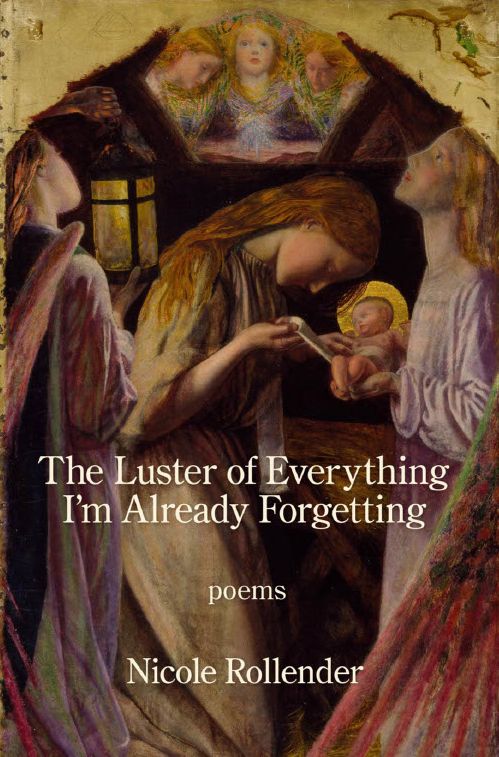
The Luster of Everything I’m Already Forgetting by Nicole Rollender
Kelsay Books, July, 2023
110 pages
Michelle Reale is the author of several poetry and flash collections, including Season of Subtraction (Bordighera Press, 2019) and Blood Memory (Idea Press), and In the Year of Hurricane Agnes (Alien Buddha Press). She is the Founding and Managing Editor for both OVUNQUE SIAMO: New Italian-American Writing and The Red Fern Review.
 Heart of Flesh Literary Journal