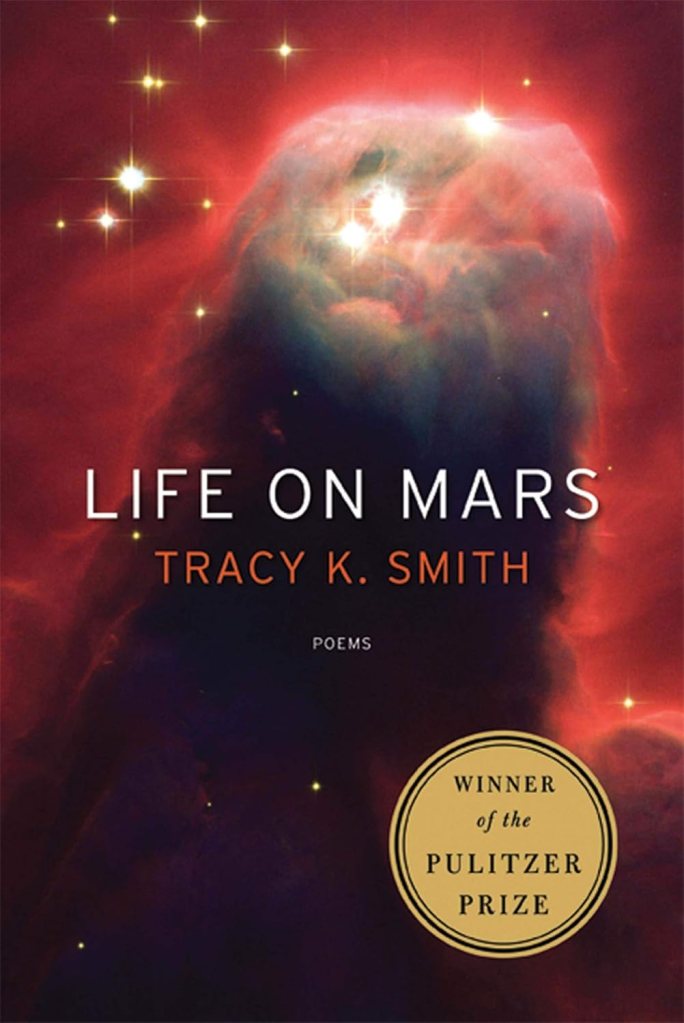
I am an aspiring poet, and I look to other poets to inspire me. One such poet is Tracy K. Smith—the 22nd Poet Laureate of the United States (2017-2019). In Life on Mars, awarded the 2012 Pulitzer Prize in Poetry, Smith reflects on her father (an engineer for the Hubble Space Telescope), life, and even the universe, especially Earth’s future. She articulates these reflections through her immensely transformative and courageous poetic style—ranging from the lyrical to the narrative. In the poems, Smith undertakes the grueling task of holding up a mirror not only to herself but also to the reader.
One way Smith manages this task is through narrating her own experience, both as a child in remembering her father and as an adult in confronting humanity’s survival. We can feel what it is like to be in Smith’s shoes, through the phraseology, syntax, and style, as well as internal and external rhyme and assonance, of her poems. It is clear Smith knows what she is doing and does so with upmost intent and care, in order to relate accurately and effectively her struggles in life. For example, in “The Speed of Belief”—a poem written in memoriam for her father—her thoughts are insightfully perceptive: “I didn’t want to believe / What we believe in those rooms: / That we are blessed, letting go” (p. 27). Smith bravely gives expression to the belief that she needs to mourn for her father, and not to repress her feelings with a “false” belief that she is “blessed” by “letting go.” Her vulnerability permeates throughout this poem, as it does throughout the book.
In her poems, Smith creates empathy and exudes a higher level of compassion and understanding for all life. And she knows when and how to ask pertinent questions—the questions which every person must ask to live a flourishing life. Smith does not seek to analyze and proselytize others, but rather to observe and reflect her surroundings. In doing so, she leaves no leaf unturned. And she is not afraid to do so.
Each poem serves as its own world in this solar system of a book. Each world opens new doors and insights to be explored, leaving the reader inspired and not the same after reading it. Each poem’s rich inner life is achieved through the poet’s ability to let her ego step aside to allow a higher self to emerge, shining forth through the pen. This is evident in her honesty, which at times can be brutal. The topics she tackles are not easy ones—from our oceans being depleted and social oppression, especially sexism, to pondering existence by trying to put a name on “it:” “Whether it will bend down to greet us like a father, / Or swallow us like a furnace” (p. 57).
In sum, Smith’s book of poems is a brilliant and fascinating collection that strives to heal the planet, the universe, and our souls. Every poetic line provokes a sense of wonder and appreciation for things seen and unseen. We cannot help but to examine our lives after reading this work of art. And we are revitalized and reinvigorated to feel a sense of duty to be loving persons and caring stewards of one another and of the Earth—if not the universe itself. Through the use of the written word in poetic form, Smith dissolves the boundaries and barriers that we often erect between reality and self. Life on Mars is aptly named for the idea that what we think we know is often simply an illusion. Smith’s poetry reminds us of our true humble selves and of the only thing that is real, i.e. love. And such poetry inspires me to live a life on Mars—a life of envisioning new worlds.
Life on Mars by Tracy K. Smith
Gray Wolf Press, May, 2011
88 pages
Margaret Marcum has an MFA in creative writing from Florida Atlantic University and teaches at Baylor University. Her creative writing has been published in various literary magazines. She is the author of the poetry chapbook, Recognition of Movement (Bottlecap Press, 2023), and the micro-chapbook, Torch of Enlightenment (Origami Poems Project, 2024).
 Heart of Flesh Literary Journal