
Introduction
From my earliest days, the Genesis stories captured my boyish imagination. The origin of the universe, tales of lost innocence and skullduggery; what drama, what depravity and, as in the case of Joseph and his brothers — what redemption!
Encountering Reading Genesis in my sixties, I am chastened. Prolonged exposure to a religious sub-culture of self-righteousness (“spiritual privilege”), uninformed exegesis of Scripture, and my mere humanity have betrayed me. My feet of clay crumble as I ponder the eloquent and gracious pleadings of our writer. As Ephesians 2:8 (NEV) teaches (“this is not your own doing; it is the gift of God”) and as this book pleads, I’d best learn to eschew any sense of merit and cling ferociously to grace.
Marilynne Robinson has renown as a novelist. Gilead won her a Pulitzer Prize. In her more philosophical works, she shows a polymathic agility with literature, history, and science that commands respect and attention.
In Genesis, she pleads eloquently and graciously for a reading of Genesis as literature first and foremost, as opposed to an ideological tool or device (whether by schools of “higher criticism” or “creationism”). She argues adamantly that the authorship, regardless of its composition, deserves attention because they show all the marks of genuineness as artists, thinkers, and spiritual participants (as opposed to detached observers or critics).
C. S. Lewis, in “The Weight of Glory,” rebukes skeptics who ask, “Is the Bible poetry?” The question they mean to ask is this: “Is the Bible merely [italics mine] poetry?” They assert that poetry — like Scripture — doesn’t matter, cannot be trusted, and doesn’t deserve our attention. For Ms. Robinson, as with Mr. Lewis, the question that begs a reply is this: “Does the Bible matter? If so, how and to whom?” She answers
resoundingly: “Yes! It matters in every conceivable way to every person.”
The arguments from history
Critics routinely invoke temporal and cultural contexts when examining historicity, but for both secularist and literalist readers, neglect them when reading the ancient narratives as literature. Our writer gently but persistently shows that the Hebrew versions, while not unique, are distinctly different, and that those differences are both profound and transformative.
She dispels but does not mock the notion that the earliest stories are “historical fact” in the modern scientific sense, implying that Adam and Eve, Cain and Abel and others up to and including Noah, might be fictional. This assumption does not, for her argument, weaken the case for the importance, the veracity, or the authority of the Scriptures.
Either way, the characters in Genesis are all “real” in the essence of their brokenness. For example, Abraham twice describes his wife, Sarah, as his sister to protect himself from being killed by foreign kings. He impregnates his wife’s maid, Hagar, having lost his faith in God’s promise. Adam and Eve, Noah, Isaac, Rebekah, Jacob and his twelve sons — all fallen, yet all “saved by grace.” The historical details are not paramount — the story of God’s grace trumps all!
Likewise for the secularist modernist: the God who listens to pleas for help and changes his intention for punishment does not thus make his/their character inconsistent. In stark contrast to the remote, uncaring immutability of the other gods of the era and area, Elohim is responsive!
Historicity and veracity
The current reference to “my truth” or “your truth” cements the notion that trying to reconcile differing perspectives is futile — or even dangerous. Robinson, however, is no fatalist. She contends that the import and meaning of the story justify its telling. As a writer of fiction, she recognizes a good story when she hears one — and she considers this one of the best!
For the modern creationist, this may seem heresy and a devilish, modern liberal scheme. However, most Christians historically did not argue about such viewpoints, because as non-essentials, they distract from the gospel fundamentals (see 1 Tim. 1:4; Tit. 3:9)! Even today, many evangelical scholars consider the tradition of “seven 24-hour days” as recent and as a poor exegesis of the text (e.g., Marty Solomon on “The BEMA Podcast, BEMA Discipleship”: Season 1, Episode 1).
Conversely, a “higher criticism” approach would reduce these stories to mere expressions of opinion. Robinson remonstrates that the narrators displayed a blatant humility and reverence that precludes such trivial approaches. Literary honesty and theological alignment — the “ring of truth” — carry the day, not historical “proof.”
The import
The God of Genesis works to bless not only his chosen people, but his entire creation, right from the start. His blesses Abraham, but even more so, Melchizedek — a pagan king and priest. Righteousness and evil admix not only in our protagonists but in the “losers” — Cain, the pharaoh of Egypt, Abimelech, Lot, Esau, Hagar, Ishmael, etc. God exercises abundant grace towards all these characters. Here, in the Biblical Genesis and in this book about it, reside proof positive that only by miraculous grace could God’s promises to Abraham — and to us — ever be fulfilled. And this IS the gospel message.
Editor’s Note: Book reviews reflect the opinions of the respective reviewers, and not necessarily those of the editor of Heart of Flesh.
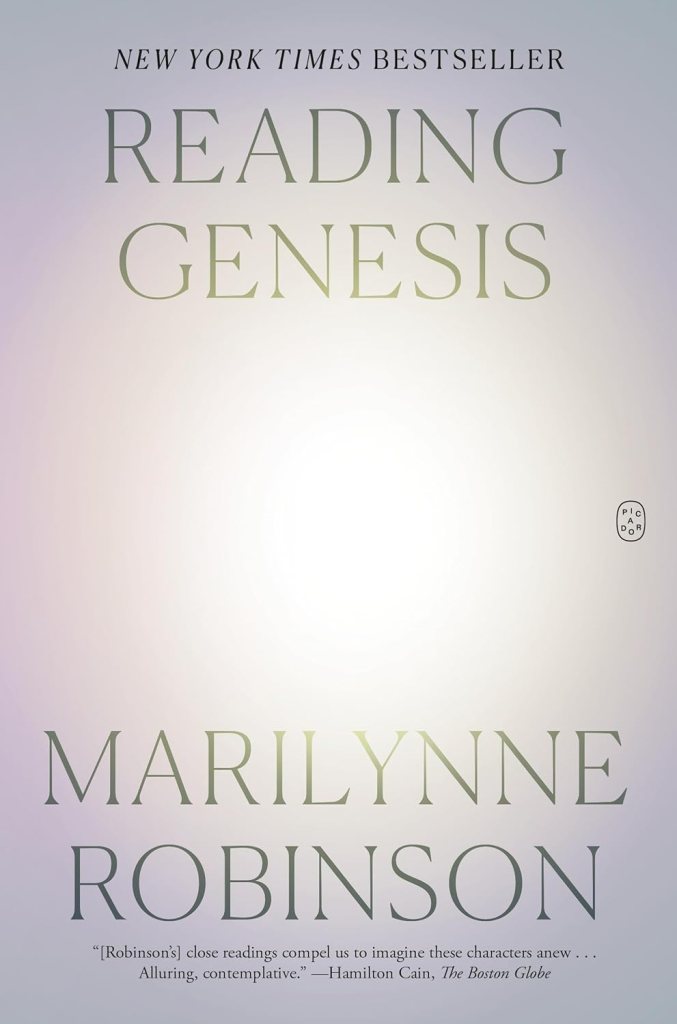
Reading Genesis by Marilynne Robinson
Farrar, Straus and Giroux, March 2024
354 pages
A bookworm since his childhood, Randy (now retired) still loves to read and write. A long-time fan of the Bible and of fiction, he remains enchanted with the God who acts and speaks in the world — and with how we respond.
 Heart of Flesh Literary Journal
Excellent review, Randy. While I may not come to the same conclusions that (the better educated and more skilled) Robinson does, it still sounds like an engaging and interesting read.
LikeLike