When I first met Malcolm Guite, I thought he looked like a mariner (not a particularly ancient one, but with a convincing beard): there he was, standing in the Old Hall of Girton College in his academic robe, chattering cheerfully with some students. It was only when my friend recommended the Girton Poetry Group that I was introduced to his creative side. And what a side it is! Part rock ‘n’ roller, part teacher, priest and poet, Malcolm is a joy to listen to. He can pull literary references from his extensive back pocket at a moment’s notice, and his work always strikes me as wise and spiritually alive, attentive to super-material realities.
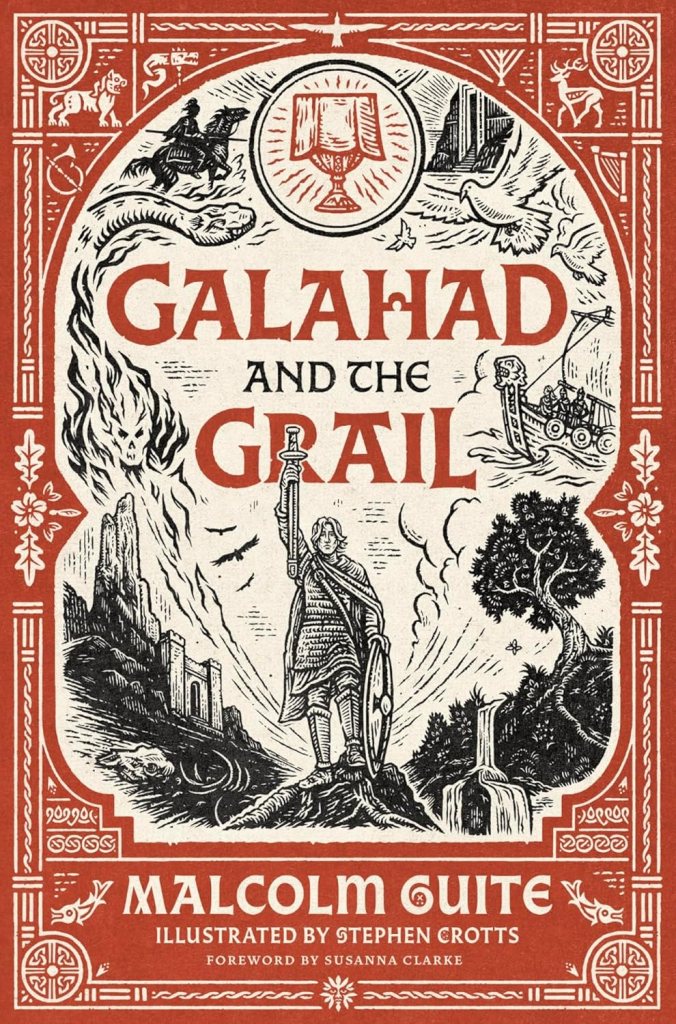
Having enjoyed After Prayer (2019), Lifting the Veil (2021) and Parable and Paradox (2016), I was excited to hear about the publication of Galahad and the Grail, the first of an ambitious four-volume project, Merlin’s Isle: an Arthurian retelling, Christian allegory and Tolkien, C.S. Lewis, T.S. Eliot and Coleridge fan epic rolled into one.
I love how unashamedly antiquated Galahad is; I listened to it as an audiobook, and hearing Malcolm’s dulcet tones is like listening to a sixteenth-century bard on a cosy autumn night. It is a pleasure to inhabit a Herbert-, or even Chaucer-esque realm for a while, dwelling in words and rhythms which are part of our cultural heritage and yet sadly fading from view in an age of TikTok reels, Netflix shows and 99p romances. Malcolm’s work scans beautifully and he allows repetition to bear narrative and melodic weight, reminding us that the artist’s role is not necessarily to make new things, but to make things new — revivifying old traditions for a modern audience, catching one’s imagination with renewed visions of the past.
A particular strength of Galahad and the Grail is its ability to draw on scriptural and literary references in interesting ways to surprise and delight the reader. This is especially true when it comes to natural imagery. Percivale is likened to a deer panting for water (as in Psalm 42); and this need for clean and refreshing streams is returned to later in the narrative, as Galahad comes across a naiad’s river polluted by a corrupt knight who, in his lust for money, has bridged the burn, churned and dirtied its water with a wheel. When Galahad helps heal the stream, the naiad can aid him and his fellow knights in their quest, which ultimately allows them to pass through the Veil to the Uttermost West (a Tolkien reference), where the Heavenly King dwells. Nature thus rings with deeper resonances throughout the work, its and humanity’s longing for new creation combined in ecological and spiritual endeavour. As in C.S. Lewis, trees are personified as dryads and naiads, bringing ethical and spiritual realities home even as the poet desires good to be passed down to the next generation: ‘Tell this tale all down the years and let your children learn that woods and stream and earth and air are kin and friends and fellow heirs, not slaves or tools, and let them share in God’s bounty and be thankful there for oak and ash and thorn’ (Book Three, Stave VII). If the corrupt knight has turned into a machine in his avarice, then Galahad hankers with the natural world around him after the healing which comes beyond the Veil — the healing Christ has won. This ecological focus is strikingly relevant for a work so familiar in feel and message; and through it, Malcolm joins Wendell Berry in the growing pantheon of Christian eco-poets.
There is a transcendence of lasting value in this work. I feel lifted heavenward through it; the rhythm and rhyme combine to create an unashamedly Christian text which is also an accomplished work of literature. It gives the assurance of being part of something larger than ourselves which has been sensed throughout time and yet never fully comprehended. It is an epic rooted in the British Isles — referencing red and white roses, the River Severn, Wales and Cornwall — and yet a story for all; saturated with a literary and spiritual inheritance which Malcolm longs to pass on. Susanna Clarke is thus right to note in her Foreword that Galahad is written against the extinction of Arthurian legend; yet there is more here than pure human story. Spiritual truths lie behind the Veil. Even as Galahad draws closer to the Grail, the Veil is pulled back and the joys of relationship with God revealed more and more. When they finally reach the end of their quest, the knights encounter God in a moment of Creation of Adam closeness — for Galahad in particular, the face of God is bared and participation in the Host renders the banquet hall a ‘thin place’ of presence and revelation. Spiritual sight, it seems, gives way to physical here, as Moses’ did on Sinai. Part of what makes Galahad a pleasure to read is its utterly uncynical, spiritually refreshing perspective; through it, the reader is borne up towards paradise and the delights it holds —and revitalised for the ‘quest of joy, quest of tears, quest of the Holy Grail’. In a word, Galahad and the Grail renders the Gospel enticing, joyous and true.
Yet there remain points for improvement. As Malcolm draws heavily on allegorical depictions of Christ (particularly C.S. Lewis’), his narrative sometimes becomes too thick to wade through. For instance, in one scene, Galahad protects a lion from a snake; what seems a simple depiction of Christ (the Lion of Judah) and Satan (the Serpent) is in fact quite complicated. Galahad is comforted by resting his hand in the lion’s mane as Susan and Lucy do in The Lion, the Witch and the Wardrobe; and yet doesn’t this scene suggest that Galahad has saved Christ? Galahad is presented throughout as a Christ figure himself — the child who will grow up to save the land — and yet he repeatedly calls on the Lord for aid in his quest. There are types of Christ throughout the Old Testament, from Isaac to Moses to David, and so Malcolm is not doing something new here; and admittedly, he is somewhat constrained by the legends his tale is based on. Yet I think he gets a little run away with his Lewis references, rendering the allegory over-complicated. Something is lost in the crisscrossing cords of lion, knight and saviour throughout the text; greater clarity would have achieved as much without sacrificing the narrative flow.
Galahad’s presentation of women is also confused. Whilst Malcolm makes a clear effort to include women as agents in the narrative, his attempts meet with varying success. Dindraine abandons the traditional constraints of hearth and home to follow her ‘own quest’, and is even ‘ordained’ by a hermit; at one point she states that she can speak on her own behalf, and the male knights around her declare that she is not ‘frail’. Yet that word returns when Dindraine sacrifices her life to bring a sick princess back to health and is described as ‘so frail and fair’. Whilst Dindraine enables the male adventurers to continue on their way, and thus arguably plays an important narrative role, both she and Elaine ultimately fade out of the narrative, leaving Galahad, Bors and Percivale to achieve the Grail and celebrate in a great, transcendent feast. The women who remain, Blanche-Fleur and Guinevere, are secondary characters whose interest depends largely on their male counterparts: Guinevere because she represents Lancelot’s redeemed desire, and Blanche-Fleur because she stands for Percivale’s finally-achieved ideal. Although Malcolm’s intent to level the playing field is admirable, the result is thus a regrettably familiar set of gender relations.
Yet Galahad and the Grail remains an enviable text which not only works masterfully with the sense and texture of words but also presents the Gospel in accessible terms. It opens wide the door to redemption, and presents Lancelot’s whole-ing and healing as a metaphor for the joyful experience of God’s love freely offered to all. Like Bunyan’s, Malcolm Guite’s is a poetic and a gospel work; it moves between physical and metaphysical levels, placing even the suspecting reader under its spell. I could not help but shiver in wonder at the final line: ‘And so I’ve taken up the tale and passed it onto you.’
Galahad and the Grail by Malcolm Guite
Rabbit Room Press, April 2026
372 pages
Jemimah Hawkes is a poet and writer from London. After studying Modern and Medieval Languages at Cambridge University, she took an MA in Poetry at Royal Holloway, University of London, and is now working as Assistant Editor for the Lutterworth Press. She lives with her husband in Cambridge, UK. https://hazelpress.co.uk/jemimah-hawkes/

