FICTION
Landing
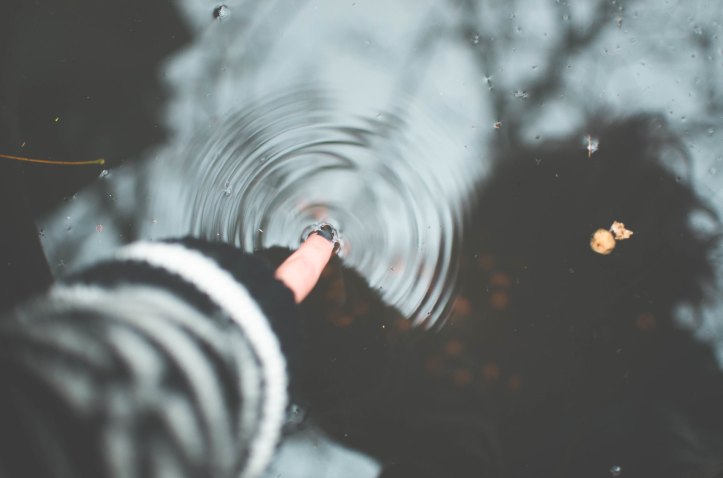
It was an hour before the sun came up, and he had never seen the lake so still. Tiny ripples came from occasional drops of condensation off the dock. Each drop caused a widening circle to gently spread past the frames of the boat hoists, heading out to the open water of the lake.
He closed his eyes, thinking of a poem he read in school, something about the widening gyre of a falcon. He couldn’t remember what it was supposed to mean. But the widening part he remembered, and it gave the ripples greater significance. He wished he could remember the rest.
Into this stillness at the end of the dock came the sound of an engine. As it grew near, he could also hear the radio pounding through the dim early morning. He turned and watched the car drive down to the edge of the boat landing and stop. The radio stayed on for a second, then shut off. All was quiet again.
The driver’s door clattered open, and a woman stepped out. She stared at the lake, then reached in and shut off the lights. She lit a cigarette and looked down at the tiny rocks in the water. He turned back around, staring at the distant shore, more visible now than even a few moments ago.
At first, he thought it was laughter, but when he glanced back she was sitting on the landing by her car, crying. He saw this with a sinking heart, and before he really was aware of it, his feet were under him, walking down the dock. No, it’s not my place to intrude, he thought. Let people do what they need to do. But at the end, he stepped down onto the sand and walked to the landing.
She looked up as he approached. “I’m not supposed to be here.”
“Hi. No, you’re fine. You’re okay.” These were the first words he had spoken aloud, and he paused, clearing his throat. “I mean, is everything all right?”
“Oh. Yeah, I’m …” She looked at the water. “It’s just—” She laughed, making a gesture that could mean anything.
“Yep.” He nodded, giving a full endorsement to whatever she meant. “I know.” He looked out over the water.
“Ya know, I went to the post office in that little town back there.”
“Right. The one in town.”
“And I thought that was the one for the lake.”
“No. Well, it’s for part of the lake.”
“So I call him, wake his ass up, and he tells me to go to this road, and take it west.”
“He didn’t know it ends at the lake?”
“No. He knew.”
“Oh.”
“He sends shit general delivery just to screw with me.” A child’s murmur came from the back seat. “I know, honey,” she called out to the tiny voice.
“There is a post office on the other side of the lake.”
The woman nodded, staring down at the water a few inches away from her tires.
“I could draw you a map.”
“I don’t have paper or a pen.”
“I mean, in the sand. I could draw you a map of the lake and—”
She brushed away his words with the back of a limp hand. “No thanks. Really.”
“That’s a pretty stinkin’ thing to do,” he said. “This fellow—”
“He’s tryin’ to kill me.”
“What?”
“Trying to wear me down to death.”
“Oh. Not literally. I get it. Gotcha.” He ducked down a little, trying to see into the back seat. A child was wedged between piles of bedding and two large boxes. “Well it’ll take you twenty minutes to drive around the lake, and the lake post office doesn’t open until eight, which gives you two and a half hours to kill.”
“Sleepin’.”
“What?”
“I’ll be sleeping—trying to. She already slept. Gotta get her some breakfast.” She closed her eyes and took a deep breath. He looked in the car again. A little bare foot stuck out from a quilt.
He felt a lurch in his stomach. “Park in my driveway,” he said. “Sleep all you want. Nobody’d bother you.” He felt desperation rising up like a fever. “I can get my neighbor to watch her while you sleep. In fact, do you need clothes? I got bags of my wife’s clothes.” His face was hot. He had said too much, but it kept coming out. “I got a bunch of soup. Need food? I can give you a bag of canned stuff. All still good.”
She stared at the water. “Wow. I mean, thanks, but I got a bunch of soup and some clothes for now.”
“Take it anyway. Toys, clothes, take it.” He began to cry. “Have it all … god.”
She put her hand on his shoulder. “Hey. Hey. It’s okay. We aren’t livin’ in this car. Might look like it. I just got an early start because I gotta do laundry and have it back. That’s all. It’s just how her father sends his checks, bastard. I had a map, but it was for the whole state. Then someone played Barbie house with it.”
He had assumed too much and said too much. Now he was embarrassed. He struggled to get a normal tone back in his voice, but his throat was tight, and the words sounded high and strained. “Oh, sure. Good.”
“I mean. That’s awfully nice of you.”
“Well. I got the stuff around. Haven’t taken it to Goodwill yet.” A sob started to break loose, but he stopped it with a deep breath.
“Oh.” She reached in the car and got a tissue, handing it to him. “You just lost her?”
“Three years ago.”
“How long were—”
“Fifty-two years.”
“That’s a long time.” The woman shook her head slowly. “Kids?”
He looked down. “Girls. Out West. One in Chicago, Denver, San Diego.”
There was a whine from the back seat. She turned. “Okay, honey. Mommy get you something.” She looked back. “She’s hungry. I gotta go.”
“She eat toast? I’ll make ya toast.”
“Naw, I don’t want to trouble ya.”
“Trouble? It’d be a pleasure—doing something for someone. I get tired of …” He trailed off.
She nodded and a weary smile spread across her face. “Well. I guess toast would be nice,” she said.
“Oh good.” He brightened and stood a little straighter. “I’m just up the road. I can walk it in a second. Just gimmie a head start, and I’ll get everything ready.”
“M’okay.” Turning to the lake, she said, “I’ll just wait here.”
“Yeah. It’s 455 Grouse Trail. Two streets up.”
“’K.” She had turned nearly all the way from him, facing the distant shore.
“So, you’re coming?”
“Yeah,” she said, turning back to him with her eyes closed but eyebrows up. “Yeah, sure.”
“Okay, see you in a few minutes.” He turned and went quickly up the road, then thinking the better of it, turned into the woods, cut across a driveway, through a backyard, and into his own small yard. The shortcut got him home a few minutes faster. He took bread out of the refrigerator, put two slices in the toaster, and pressed the lever. They disappeared into their slots. He quickly set the table.
After a minute, he thought that maybe she would have a hard time seeing the numbers on the cottage. He walked to the sandy street just as he heard the car on the paved lake road. She was accelerating up the hill, but then drove past his street, the sound of her engine quickly fading to silence.
He stared until he said, “Well. That’s that.” A sick feeling spread through his stomach. Well of course she got the hell out of here! he thought. Don’t know who anybody is any more. He went inside and sat down. She did the right thing. Gotta protect your child from who knows what. But he felt singed with embarrassment and shame.
He found himself staring out a window into the woods. Through the trees, he could see his neighbor’s RV and the side of his new aluminum garage. He stared at the trees until they became foreign objects, as though the view he’d looked out on for thirty years was gone. He felt distance grow as he slipped away from himself, looking onto the strange woods with eyes that were not his own.
The toast popped up, jolting him back to the present. He put it on a plate. The butter was cold and didn’t want to slice. The jam lid was stuck. For a second, he was going to throw it all in the trash when his back door opened.
The woman stood there holding a shy, sleepy little girl, wrapped in a blanket, the back of her head a tangled nest of fine blonde hair. “They don’t make it easy,” she said.
“You’re here!”
“Yeah, well, someone needs to get a ladder and cut the branches on your street sign. I mean, not you, specifically.”
“You can read it in the winter.”
She turned to the little girl who was burying her face in her mother’s neck. “Faith. Can you say hi?” The child let out a whiny snarl. “Can you say hi?”
“She doesn’t have to.”
“She’ll warm up eventually.”
“It’s a lovely name.”
“It’s like the singer.”
He shrugged at her.
“Faith Hill?”
He shrugged again.
“Well, she’s real big.” She put the child down in a chair and the girl screeched, grabbing her mother’s sweatshirt. The woman detached her little hands and wrapped the blanket around her more. “We’re going to have toast with—I’m sorry, I don’t know your name.”
“Joe Andrews.”
“We’re going to have toast with Grampa Joe now.”
The girl removed her head from the blanket and stared at the table. He put more bread in the toaster and pressed the lever.
“I’m Tracy,” the woman said. “Faith and Tracy.”
He nodded and put strawberry jam on the table along with orange marmalade. “I don’t know which one of them she’ll want. I may need to run the strawberry under hot water. She can have both, or eggs. I can make eggs.”
The child eyed the marmalade. Her mother picked it up, and she nodded before her face went back inside the blanket.
“I didn’t think you were coming. I mean, I saw you drive by.” His chest tightened around the breath in his lungs. “Wouldn’t have blamed ya, the way things are now.”
Tracy didn’t answer. She spread marmalade on the toast and cut it into finger-width strips, handing one to the girl.
The second round of toast popped up. He got it on a plate while it was still hot.
She took the plate from him and set it down on the table, reaching for the butter. “I wasn’t going to, but …” She scrunched up her face then smiled.
“But what?”
“But I don’t know. Seemed like you needed someone to talk to, and she was hungry, so …” she tipped her head sideways to say, why not?
“Well I’m happy you came. It’s good to have—” He gestured to the little girl. “I mean, it’s been a while since we had little people in this house. He looked at her and frowned. “So now, tell me—what’s the story with this Mr. Special Delivery fellow, sending you all over? Because I don’t like the sound of—”
“No, no,” she whispered, shaking her head. “We don’t need to talk about that.” She picked up a piece of toast. “Here, grab the other corner.”
“I got a knife right—”
“No, take it.”
He did. “What are we—”
“Now pull.” The bread came apart unevenly, giving her two thirds of the slice. She tore a piece away and put it on her daughter’s plate.
He looked at the bread in his hand. “What’s this for?”
“It’s for you to eat.”
And in a flash he understood. He took a bite of the bread, then Tracy did the same. They looked at the little girl in the blanket eating her toast.
Nobody spoke.
Christopher Hadin is a naturalist, writer, and educator. He lives in Ferndale, Michigan.
Next (Paul John Hausleben) >
< Previous (J.W. Wood)
Photo: “Ripple” by Noxi., CC BY-NC 2.0 Deed, via Flickr.com.
 Heart of Flesh Literary Journal
What a beautiful story. I will be thinking about Tracy and Joe all day. I hpe they are okay.
LikeLike