FICTION
The Rattle of Bones
When the officers came into the church to arrest Ezekiel Freeman, the congregation fell into an uproar. It was easy to see why. White cops come into a mixed church on Sunday morning and arrest an elderly black man, and with no warning. Ezekiel had not resisted. Still, they pulled him to the hardwood, turning over several foldable chairs, causing even more commotion as his body scraped against the gym floor.
The morning the officers came, Byers had been calling on the grace of God in prayer. They did not answer any questions. By the time they had the old man hoisted to his feet, Byers had made his way to the back of the room shouting for answers. They walked Zeke out in handcuffs. His face looked almost regal, cut with the lines of age and void of expression, dignified in compliance, a sheep to the slaughter.
The last cop to leave closed the door, sealing off the light from the outside. No one spoke. Pastor Byers pulled his eyes from the door and began to pray.
Two years earlier, the church had been in a bad way. There had been about thirty members meeting in the old sanctuary fit for a hundred. Byers had been there about a month, teaching a congregation where the average age surpassed seventy. He had a habit of reading his sermons drily rather than delivering them with feeling.
One day, an elderly black man in overalls had come in late on a Sunday morning, after Byers had already started preaching. The congregation was all white and most of them nigh on eighty. Byers was taken with the visitor. He sat upright, his hands in his lap, unmoving in his focus on the preacher. Byers felt a new thing flow through him, and he felt his rhythm change and pick up pace. He received the Holy Spirit as he watched the old black man, and it fell and felt like fire and wind and the flow of cleansing waters.
After he closed his sermon with a tearful prayer, he placed himself in the back of the sanctuary like always, and waited to greet the parishioners. Several asked what had gotten ahold of him. It was the Spirit, he knew. He shook hands as the people left, and waited for the man who had brought the wind.
Ezekiel waited until the entire congregation had left before leaving his seat. When he came face to face with Byers, they shook hands and introduced themselves. Byers shook a little too heartily, and the old man with a serenity that set in deep behind the eyes. He was so stolid in the first moments of their friendship that the pastor was shocked when he said, “What do I need to do to be saved?”
“Ezekiel, brother, I’m happy to hear you ask that. Why don’t we sit and talk a while.” As they spoke, Zeke, as he began to call him, was stoic, unmovable, and more honest than any man he had ever known, “I have done things, preacher, that I am not proud of. Horrible things. But I want to be saved. I want to know that all the things I have done will not damn me.”
Byers was moved. He led him in the sinner’s prayer.
“Dear Jesus, I know that I am a wicked, evil sinner. I believe that you died on the cross for me, to take away my sins. I believe you rose from the dead. Please forgive me and accept me into your kingdom. Amen.”
After Zeke had repeated the whole prayer, Byers was filled with joy. He laughed and put his hand on the old man’s knee in encouragement. Zeke had not yet learned to show his happiness, but Byers could tell it was a turning point, for himself and Zeke and the people of God.
Byers found himself full of energy, and his preaching reflected it. He preached and cried out from the pulpit, and he felt the congregation begin to listen, if only to see what would come next. One Sunday, after Zeke had been with them a month, Miss Mary Dayton stood up and clapped her hands during one of the songs, and kept her hands raised for a whole chorus. She was over eighty, but she was filled with the joy of God and heaven’s angels. Two weeks later, Jim Brewer caught the Spirit during one of Pastor Byers’ sermons, and began to call out in a language none of them had ever heard. After that, someone spoke in a heavenly tongue every week.
A few months after Zeke joined them, the healings began. One woman had been wheelchair bound for most of her life. She said she began to feel heat through her legs like ants under her skin and that was the first thing she had felt below the waist in decades. The heat turned to motion and strength and she stood right up out of her chair, and began to testify to the healing power of God. Byers himself began to weep and cry out to God in praise. Ezekiel watched, though he did not laugh or cry with joy. The two men made eye contact in the celebration, and Byers thought he saw his new friend nod.
The pews began to get tighter with those coming to church for the possibility of seeing something miraculous, something wonderful. They did see many wonders. The deaf heard and the blind received their sight. The sick were made well and wombs were opened that had been shut for years. Every week, more were healed and added to the faith. Eventually, the people voted to move Sunday service into the old basketball gym that had been out of use since it had been built. Byers would cry and sing and look to the back where Ezekiel sat. He was always watching, nodding his approval and conspiracy in the end of suffering.
The miracles continued until Miss Mary Dayton died. It was a Wednesday, a year before the arrest. She had been with the prayer team in the early hours of the morning, and asked for a fellow prayer warrior to take her to the hospital shortly after. Within hours, she was dead. Her friends wept over her body and legacy in equal measure. Preparations were made and her body treated before the funeral service which would occur on Friday, so as not to disturb the church’s weekend schedule.
Byers called at Zeke’s house, which he had never done before. The driveway and yard were dirt, and the glass storm door rattled as the pastor knocked. Ezekiel answered the door in short order and if he was surprised to see his friend, he did not show it.
Byers felt something like a holy awe at being in Ezekiel’s house. There were no family pictures on the walls, nor any paintings or decorations. The man wore his overalls even in his home, and invited the pastor to sit, that same stoicism adorning his countenance.
“What can I do for you, Pastor Byers?”
“Well Zeke, I’m sure you’ve heard that sister Dayton went to be with the Lord this morning.”
Zeke nodded.
“She thought highly of you.”
“How’s that pastor?”
Byers smiled at the old man, his black face an image of resistance to his purpose, faithful, yet set against the storm of life and the power of God. Still, Byers saw God in Zeke’s face, the darkness of it like the shadow and the cloud that goes before his people.
“She loved you, in a way. She thought you might have something to do with all of it.” Zeke did not move.
Ezekiel sat, looking at the pastor, waiting. He seemed resigned, both to the death of the elderly woman and to the love the people had for him.
“She asked that you pray over her. At the end of the service, nothing special.”
Zeke waited.
“Zeke, she meant it for a compliment.” He touched the old man’s knee. “I believe she meant to honor you.”
Zeke thought for a moment. “She asked for me?”
“Wrote it right there in the will, plain as day.”
Zeke paused a beat, then nodded. “I reckon I should do it.”
Pastor Byers took the moment as a sign of Zeke’s final transformation into one of the saints. He brought the power of God into their church years ago, and now the love of God was being displayed in this tiny act of service, a prayer over the dead body of an old woman. He left the man’s house that day, knowing that the Spirit had been there too.
The funeral was the most attended in the church’s history. The men carried her in, and the casket was laid on a platform in the front of the gym where they now held service, to the side of the pulpit. It was left open. The congregation looked on the woman. She looked like any other body they had seen.
Zeke did not wear his overalls, but a button-down shirt tucked into a pair of unstained jeans. He did not wear a belt. He watched as the people celebrated the life of the woman who had become a testimony to the church’s growth. He watched as Byers called down God’s love on the people, and offered all who had not yet repented a chance to know the saving grace of God. Many came forward to be saved, in full view of the lifeless body of Mary Dayton. The faithful sang and hugged their new brothers and sisters.
After all returned to their seats, Byers stepped away from the pulpit and motioned for Zeke to come forward.
“It’s time, brother Ezekiel.”
Zeke stepped from his place in the back row. He did not take up the handheld microphone the pastor offered him, nor did he place himself behind the pulpit. He simply stood next to the casket where she lay with her hands crossed over her chest. He leaned awkwardly to one side, and did not speak for several moments. The music stopped and all were silent. He found his voice, and it came out soft, though it did not waver.
“She asked me to pray for her. I don’t know if I can.” His gaze passed over them, boring into their spirits as though he were the judge of the living and the dead. “I am not a man of prayer, really. So I’ll just say she was a good woman. She spoke kindly to me a few times. Yes, I guess Miss Dayton welcomed me. I didn’t really know her, but I felt like she saw me. Whether that was a good feeling or bad, I can’t say. I suppose I’ll miss her. I loved the way she raised her hands high when we sing. I could always tell she believed. I believed her, too.”
Zeke looked at the casket for the first time. He did not cry or flinch, and no one applauded at the closing of his words. They watched him look at the woman, at the box that held her body, and they watched as he reached out his hand to the foot of the casket.
The moment his hand touched the polished grain, there was a loud thump. He did not take his hand away. He looked at the woman, who lay lifeless. There was another thump, louder, and Pastor Byers knew it came from inside the casket.
Miss Mary Dayton’s legs kicked against the felt lining of the coffin, though her torso and face had yet to find the same life. Gasps and shrieks came from the congregation, and Byers himself involuntarily breathed, “My God!”
Only Ezekiel saw her eyes open, her hands leave her chest and grasp the fabric and pillows on the inside of what would have been her tomb. All saw her sit up, her eyes finding only the face of her resurrection. Ezekiel reached out his hand to the woman and she took it. Byers finally rushed forward, and the two men helped the woman from her casket, lowering her down awkwardly in the midst of the uproar. Her feet hit the floor and she looked out at the crowd. Her countenance shone with new life. She smiled, broad and toothy, and raised her hands up to feel her face, smoother and less wrinkled than before.
As the crowd launched into an anarchy of celebration and praise to God, she turned to hug Ezekiel, who awkwardly hugged her in return. Byers looked over Miss Dayton’s shoulder at him. He saw the face, the man of God. The blessing and the life hit him and he sunk to his knees as though he stood before an angel. He joined the praise, weeping, believing. The woman who had been dead continued to hold Ezekiel in her embrace, thanking him for her life. The celebration continued for several days. Death had lost its sting completely. They had seen it. Mary Dayton had come back to life again.
It was the same Mary Dayton who called for an impromptu prayer meeting the morning after Ezekiel’s arrest. They prayed for several hours. After prayer, they talked of him, circling up the chairs to call on memories.
The town drunk gave credit for his newfound sobriety to a handshake from Ezekiel the first Sunday he came. A young man said he had dreamed of Ezekiel telling him to come to church, that when he did, he no longer wanted to kill himself.
Miss Dayton spoke. “You all know what he did for me.” She found herself filled with emotion. “I was here the first day. He came in and sat in the back. To tell the truth, when I first saw him I was afraid. Here’s this black man in the back of our church. I was afraid. I’m ashamed of it. I can’t imagine where we’d be without him.” She paused in thought. “I guess I do know where I’d be.”
After the meeting, a group tried to go see Ezekiel, but the police would not let them in. The police were still interrogating him, but the man had not given up any of the necessary information.
On Tuesday, Byers went alone, and an officer met him in the lobby.
“Pastor Byers, would you come with me?”
Byers was led down a narrow hallway into an office. He sat down in the seat in front of the desk, the chair for the concerned, for the unaccused. The pastor spoke first. “If you have not charged Zeke, then you have to release him.”
The officer, dressed in a suit rather than a police uniform, sighed and rubbed his eyes with one hand. “We have a forty-eight-hour window. And we are nearing the end of it.”
“Y’all are wasting time. Zeke’s a good man.”
The two men stared at one another. The pastor grew impatient. “Why don’t you let me talk to him. For just a few minutes.”
The officer leaned forward, put his elbows on his desk, and interlaced his fingers. “He’s been asking for you.”
“And you don’t mention it until now? He’s probably scared half to …” Byers started to stand when the officer spoke to give him pause.
“Has Mr. Freeman ever told you about his past? Anything he’d be likely to hide?”
“He’s a sinner. Like me and you.”
“Nothing that would stick out in your mind?”
“He’s never told me anything that would land him in here.”
The officer shook his head in frustration.
“Jesus. What is it you think he’s done?”
The officer took a deep breath and leaned back in his chair. “We have reason to believe Ezekiel Freeman committed a string of murders dating back forty years. We believe he stopped killing a little over fifteen years ago. We have not found any bodies, but we believe our intuition thus far to be accurate.”
“My God. My God.” Byers struggled to find words and sat roughly back in the chair. “How could you think …”
He was cut off again by the officer, “We are not prepared to offer that information.” The officer waited. Byers did not speak. “Are you willing to speak to him?”
“Yes, of course. Take me to him.”
The officer obliged. At the door of the interrogation room, the officer grabbed Pastor Byers by the arm. “We are right outside. If he makes any threatening moves, we’ll come in.” The pastor jerked his arm from the grasp of the officer and went in alone. Ezekiel sat at a table in dirty overalls, and showed no distress.
Pastor Byers rushed to the table to talk to his friend. He spoke immediately on hearing the door close behind him. “Zeke. Are you …”
“You should sit, pastor.”
The pastor sat in the chair and started speaking again. “Have they fed you? I’m sure I can call someone to get us a meal. We should be able to clear this up if you just talk to me.” The pastor waited for Zeke to begin, but he did not. They stared at one another as the moment rolled into the next, and Byers wanted to speak but found no relief in his friend’s face. Finally, blessedly, Ezekiel Freeman broke the silence, and Byers felt a wave of something like the spirit of martyrdom unraveling and flowing down. Somehow, he knew it was the end of all things.
“Have they told you what they think I’ve done?”
“I don’t believe it. You aren’t a murderer, that much I know.”
“You should be quiet now.” Ezekiel’s voice was commanding, dominating. The pastor recoiled. “I am going to tell you the truth. They are listening. I would like you to listen too. Can you do that?”
Byers nodded, cautious. He pulled his hands away from the table and into his lap. Ezekiel sat forward, his eyes piercing Byers to the heart, and began to tell a story.
“When we first met, I told you I had done horrible things. Do you remember?” He did not wait for a response. “I came into the sanctuary that day, and I told you. I suppose it would have to come out.”
“Zeke …”
“I never wanted to be this way, I want you to understand.”
“Please … don’t.”
“Try not to speak. Once I start, I will not stop. This will be my confession. I will not make another.”
Byers shook his head in disbelief, the pain and unraveling marking his brow.
“Don’t make that face, pastor. Be strong in the Lord, and He will sustain you.”
Byers tried to listen, to understand.
“I killed my first when I was 27. She had dark skin, and black hair. She had these blue eyes that lit up, and she cried when I took her. I called her Dina, after my mother. She cried and cried up until she left this world. I was horrified at myself. I need you to know that. I was terrified at who I was. I washed my hands so much they bled and I had to burn the clothes. I felt alive, too, and that was the worst part. Because I knew I’d want to feel alive again.”
“My God.” Byers’ hand reached to his face and his fingers tapped his hairline in distress, as though they tried to beat out the thoughts that were taking root there. “My God.”
“I buried her in this vacant lot next to the church. I had never been, but something drew me there that night. I can’t explain it, and I never knew what it was until that day, until I saw you preach the Word.”
Byers’ head was spinning, splitting, and his hand balled before his mouth to keep from vomiting. He did not speak, but tears flowed freely from his eyes.
“Forgive me, but I must finish. I must confess to find healing. There are others. They all lie there in that lot. It comforts me to know that they are close to the house of God.”
Byers jumped up to the door and emptied himself into the trashcan next to it. He reached for the handle, but did not test it. He faced Zeke with vomit on his shirt, and wiped his face. He knew what he had to do and prayed for strength. He sat back down.
Ezekiel smiled. It occurred to the pastor that he had never seen the man smile before.
“I am confessing to you that I killed them. I used them and then I killed them. I am sure by now you know what made me stop.”
Byers broke from his emotion to think. “The gym.”
“Yes, sir. When the pastor before you built that gym over my sacred place, he hoped people would see it and be drawn. It didn’t draw others, but it drew me. I tried once after it was built. A girl passing through town. But I knew if she couldn’t be there with the others, with God, then it wouldn’t be the same. Would you believe it took me fifteen years to come into the church after that?”
Byers’ emotions mixed and roiled in his mind. “You came into our flock, and made us all believe. You had people thinking you were sent by God.”
“Wasn’t I? You saw the sick healed. The blind and deaf and barren. Wasn’t I His messenger?”
Byers stumbled over his words trying to find the right ones. He choked it out. “God would not abide … His vessel tainted by all this death.” Byers shook his head involuntarily. There was a breaking. “You are death.”
“The church was dead when I came, pastor. You remember. I may have brought death with me. I am a sinner after all. But you did too. And when your death met mine, there was life.”
“I never killed anyone. Miss Dayton, the others. You betrayed them.”
“There is no one who does good. That’s what the Book says. Not even one.”
Byers realized, suddenly, that he could not listen for another second. He could not bear it. He stood and turned to leave.
“Pastor, please.”
Byers faced Ezekiel Freeman for the last time. “Was any of it real?”
“I know the way it felt for me.”
Byers shook his head. He was going to be sick again.
Ezekiel’s face held the same stoicism Byers always thought to be holiness. He knew now that the eyes were dead, the body full of darkness. Ezekiel spoke from underneath the eyes. “Do you forgive me?”
Byers stared at the man handcuffed to the table for what seemed like an eternity.
“Do you think God does?” The pastor asked in earnest for both of them. Would God forgive Byers for allowing the angel of death to deceive the flock?
Ezekiel did not skip a beat, but spoke with confidence that Byers once attributed to the Spirit. “I know he has.”
Byers left the room and did not respond to the officers trying to stop him in the hallway. He drove home, taking another way so as not to pass the church, the burial ground for the victims of a man he once thought was his friend, the very power of God.
The next morning, Byers rose at home after a sleepless night. He turned the TV to the news and watched as they ravaged the gym. They began their work on the floor at the place where Mary Dayton had been recalled to life. He watched as they broke through and pulled up the bones of young women. They were dry and covered in dirt. He wept as the faces that had once belonged to the bones were displayed on the screen.
He turned off the TV and went to the dining room table where his Bible lay. He opened it to try and find a passage for Sunday morning. He hoped he would find a passage on God’s justice, or forgiveness, or miracles of life borne from the graveyard of human suffering and despair. He found them in the same places he always did. Still, his tears fell on the pages and the words he read did not make sense. He closed the book and looked out the window for a while. He knew that the life had gone out of him, that the wind in his soul had gone away.
Hampton D. Harmon currently lives in Houston, Texas, with his wife, daughter, and dog. He is a middle school teacher and previously studied Religion and English at both the undergraduate and graduate levels in hopes that his interests would align in his writing. His short story, “Second Wind,” was printed in Clockhouse Journal, as well as an essay on the Murdaugh murders with the Dead Mule Society. This story, titled “Rattle of Bones,” fits his thematic interests as a writer and showcases his growth in the craft.
Next (Paul Michael Garrison) >
< Previous (Rachel Michelle Collier)
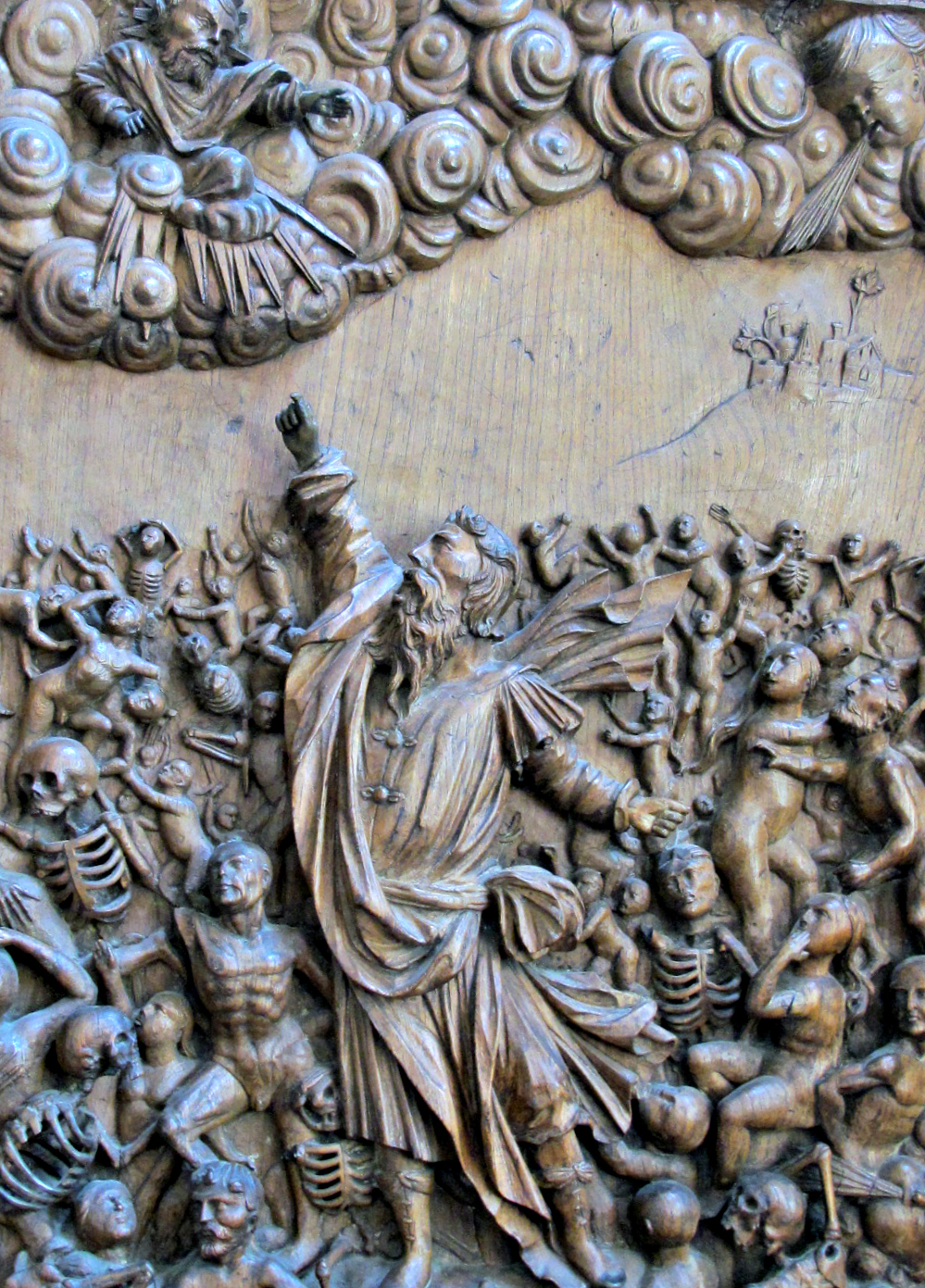
Image: The Valley of the Dry Bones by Grinling Gibbons. Photo by Maggie Jones, via Flickr.com. Public Domain.
 Heart of Flesh Literary Journal