NONFICTION
I Briefly Stop Believing in God at Church the Morning After a Hozier Concert
In an attempt at poetry, the pastor called it a “drizzly, late summer day.” The good, clean Christians of San Diego filed into the rows of white chairs with their perfectly arranged hair and cake-topper babydoll dresses, slurping coffee from earth-colored mugs they bought at Target and greeting only the familiar faces around them. I’ve never met anyone I didn’t already know here, in this outreaching, disciple-focused church. The sanctuary looked built to house Pinterest weddings and keep its residents happy all the days of their lives, and the people looked like they hated poverty and wouldn’t lift a finger against it as long as they could come up with excuses not to. The pastor had a stupid haircut and a lyrical lilt in his voice just smug enough to match a narcissistic uncle at Thanksgiving. When he introduced the Holy Spirit as the topic for the week, I practically rolled my eyes.

The talented duo leading worship beautifully played “In Christ Alone,” and probably some other songs, but all I heard, loud and clear through the flawless bass-boosted speaker that is sleep-deprived memory, was Hozier, howling “Take Me To Church” with the conviction of a man refusing his last meal.

The pastor’s salt-and-pepper face and the gray windows picture-framing him bleared into the background as my mind cast a different image over it: the artist from the night before, calling for a different devotion than I’ve known.


The guilt I feel when listening to Hozier’s blasphemous ballads is overshadowed by the unmitigated soul-walloping I get from his rhythm ‘n blues. Some spirit takes over when the music waxes, and I feel close to God, or to something, despite the particular flavor of his lyrics. The guilt I feel at paying the man, who seems to hate my faith, $40 so I could hear him play live is perhaps more substantial, but it was admittedly soothed by the fact that I didn’t do it alone. My best friend leaned over during the worst-offending song and laughed, “A little blasphemy never hurt anybody!” before launching back into song.


The pastor started doing that Christian thing where they over-preach about a passage we’ve heard before, but analyzing it with some fresh new bit of context, some new angle, hot off the Jerusalem Press, that no one’s apparently come up with in two thousand years.

This time Apollos was the victim, for that time he preached about Jesus “accurately, but not adequately,” for only knowing about the baptism of John.

He’d missed out on the Holy Spirit.


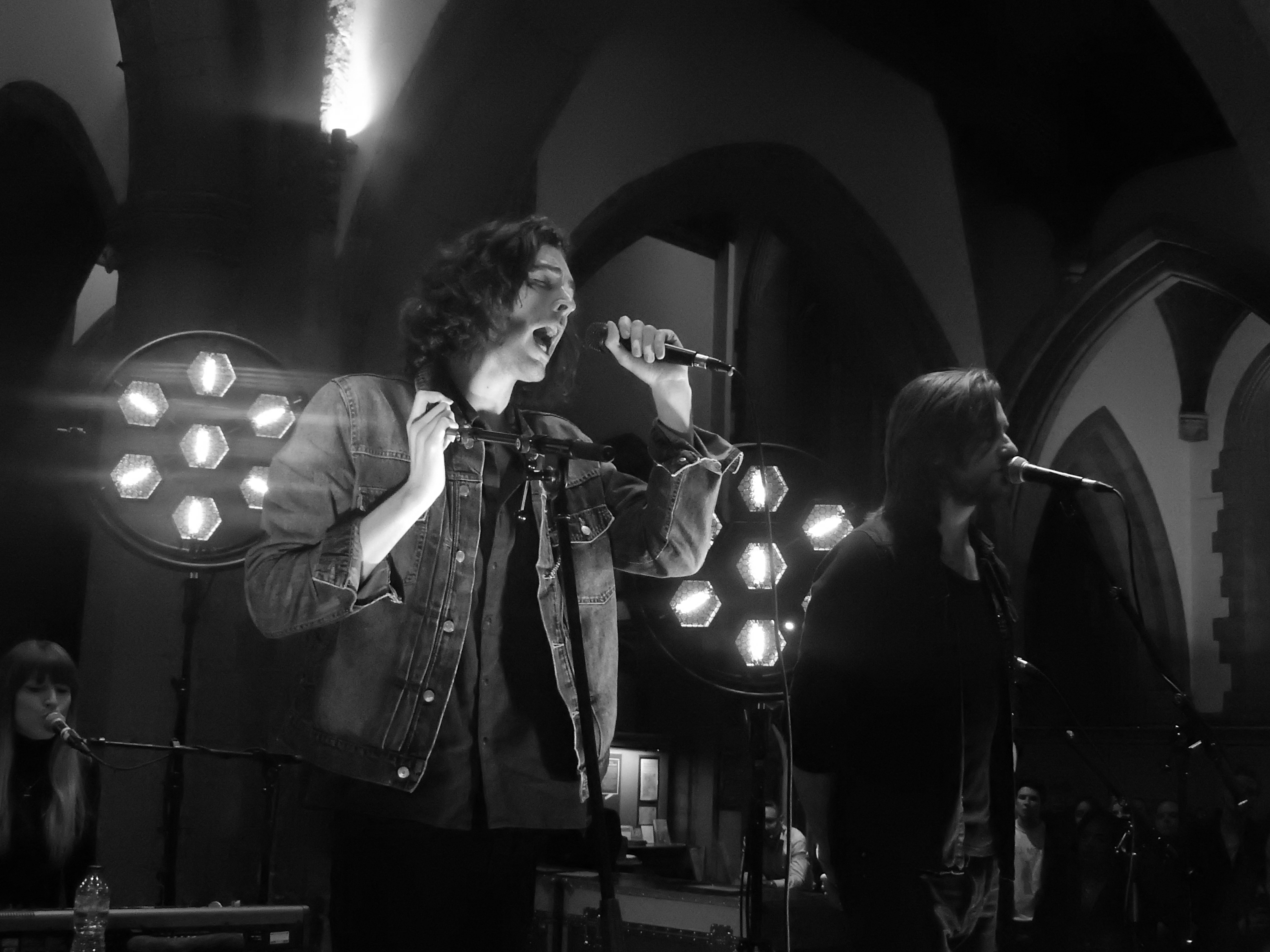
The lights bloomed awake, outlining him in a whisper of blue, and from the still-dark stage, his voice like cello strings bowed out over seventeen thousand devotees.

Thousands of people screamed in adulation, but all I could hear was the silence of the night holding its breath, and the murmur of his fingers kissing the strings, and his voice, oh my lord his voice.

In the religion of music, every noise is worship, every throat a temple. The spirit of sound, a being of pure emotion dripping with some sort of reverence, takes over, goosebumps delivering its warm touch, and brings a high so pure it could convert a person to any faith.

He sang like heaven paled before a woman’s touch, like he held my God and all His followers in contempt, and like at the end, if given a second chance, he’d jump from the pearly gates to meet his lover where heaven’s light would never fall on his skin.

But in between songs, he preached gratitude and ceasefire, a revolution of love through protest. He called us to arms. He addressed every group of people and prayed their release from oppression. He implored us radical young to speak for those who need our voices, and continue the change that others started for us.

How could someone with no religious conviction care enough to take action for God’s people, when my church, this room full of pure and holy saints, stayed still?


In the summer and winter church camps of youth, hundreds of bleary-eyed teenagers gathered in dark, tightly packed sanctuaries with blaring siren lights and smoke machines that declared Jesus’ name like John the Baptist in the wilderness, if John had had access to disco balls and LED lights. For some of us, this was our first experience with live music, outside of our little Baptist and nondenominational churches, and we were riveted. The close community, sleep deprivation, and powerful sound racked our pubescent bodies and left us in awe, many of us having what we believed were revelations of the Holy Spirit, and rededicating our lives to Christ. Over the seven years from 6th to 12th grade, some of us rededicated two or even three times, without a thought as to whether each dedication negated the last.

You’d think the melodies sung by the autumn-evening mouth of Andrew Hozier-Byrne hold a different kind of worship than the Christian camps of old, but the spirit that takes over during these tsunamis of sound is the same. It’s not exclusively holy, and not exclusively otherwise.


The worship duo played another song I can’t remember. “Take Me to Church” banged through my head louder, and felt righter. The real and imagined songs blurred together into a squall of sound I lost myself to. Swaying on unsteady legs, I closed my eyes and opened my hands, feeling only the call of the music, and for a second, unsure of what I was listening to anymore, as the inhibition left my body, I tilted my head back and forgot who I was singing to. There existed only sound. No man, no ground, no walls, no friends, no devotion, no God — no God? My eyes flew open.


A few weeks ago, I saw a man begging in the middle of the road around ten thirty on a quiet night. Without thinking, I scrambled to my purse, flipping through hand sanitizer and chapstick, and racing the ticking stoplight, slapped at my legs until I found the twenty dollars in odd bills I’d folded in my back pocket. I stuffed my hand through the half-open window, the wad budding from my two fingers.

I’d never done that before, and often use the “don’t give homeless people money, they’ll just spend it on drugs” maxim as an excuse to give nothing at all. Sometimes I hear my dad or my church leaders telling me not to help people at the expense of myself, and that homeless people are unpredictable, and it’s dangerous.

But this time, I wasn’t thinking for myself. Some spirit took over. And this time, it had nothing to do with music.


The worship band still stood there, mouths open in reverence and eyes closed, bathed in yellow light. Their words refocused into recognizable sentences, and the words became my prayer, not the music or the feeling.


The man in front of us at the concert, a short, red-haired thing with a mischievous smile, blew vape clouds in our faces at a rate that suggested someone paid him to do so. A pair of nineteen-looking-year-olds spent the night grabbing each other’s throats to aid in their endeavor to lick each other’s tonsils, half a foot from my friend’s face. The wasted trio behind us sang so loudly and poorly that it overpowered the music from the stage. And the singer himself, poor man, had such dark circles under his eyes, and didn’t smile once, for the entire 23-song set.

Most of the night’s romance embedded itself into the memory in hindsight, my desire to be a part of something good fueling the reverie that I wanted so desperately to be the Holy Spirit.

But the Holy Spirit is quiet, and kind, and speaks at a whisper. I have to turn off the music, and let that other spirit wither to hear Him.

The artist gave some pretty speeches about power and love, but the weight of his entire year on tour hung from his tired voice, the practiced air of his sermon curdling the words. For all the crying about revolution from the audience, we’d all spent money on that concert that could’ve gone toward the causes most of us had just been cheering.
Milla Jade Kuiper is a young writer who loves Appalachian music and tracking the patterns of the stars. She is still learning who Jesus is. If you like her work, you can also find her in Academy of the Heart and Mind and Garfield Lake Review.
Next (Timothy Horne) >
< Previous (Jessica Lynne Henkle)
Image: Hozier, All Saints Church, Kingston Upon Thames photo by Drew de F Fawkes, CC BY 2.0, via Flickr.com.
 Heart of Flesh Literary Journal