FICTION
Knee High by the Fourth of July
The last thing I remembered was lifting the light high enough for her to escape before the creek could drown me.
My twin sister and I hadn’t hung out for a while. I’d been busy with friends. Benny finally got his license, and his parents let him take their Jeep wherever he wanted. I felt bad for ditching her all the time, but Benny was two grades ahead of me and the starting fullback on the football team. Even when we had no place to be, we always had somewhere to drive. We’d tear through three feet of sloppy mud in Shakem Valley after rainstorms, see who could burn the blackest patch of rubber against Wal-Mart’s parking lot, and tinker with wires attached to the refrigerator-sized subwoofer that pulverized our eardrums. We sucked down full-flavored cigarettes while Black Sabbath (and other bands my dad disapproved of) punched sonic ripples into the Jeep’s canvas walls.
Rachel didn’t have many friends. By the end of freshman year, I’d become athletic, which made me popular, which made me practically invincible. Rachel was shy, scrawny, and permanently attached to headphones in a way that screamed antisocial. I marched through the world like it was a place to be conquered, a sort of chain link fence I’d leap over easily. She stumbled around the same world like it was a cage she could easily step out of but didn’t particularly care to, an old soul who’d suffered an unseen amputation that I alone knew about. She had always been my best friend; I mean, our DNA was literally intertwined. But now, as differences in our identities began to fossilize, I could see our path fork in two.
Regardless, I promised her we’d hang out tonight, just the two of us.
The necessary preparations had been made. I replaced the water in a plastic bottle with cheap vodka Benny bought for me with his fake ID. Rachel snuck a fat pinch of weed from Dad’s not-so-secret stash in the garage — he kept it behind the chest freezer inside a collectible E.T. lunchbox. We also borrowed Dad’s road bike — he was an amateur cyclist who, at the time, was nursing a cracked tibia. We figured he wouldn’t need the $3,500 roadster anytime soon. Rachel propped her bony butt onto the handlebars like always — we were the only kids in town that never had our own bikes; mom forbade it due to the way her sister was killed. We never got the full story. The answer to our incessant begging was simply, “Never.”
So if we ever got our hands on a bike, we had to maximize the space. Rachel sat on the handlebars while I drove. We were 14 and a half now, and she had grown taller. But, somehow, she wasn’t heavier. I was tall and heavy with new muscle. I was a man.
Neither of us knew it, but this would be the final time the tandem-bike-on-a-single-bike technique worked for us.
I pedaled out of the village toward Mill Street Hill, a straight and steep strip of country road that led to the water. The Cattaraugus Creek cut through three counties long before those counties existed. On hazy summer days — the ones where Mondays feel like Fridays — the creek’s cool water coaxed bored kids. It called to us now, a snake that wrapped its tongue around our bike and reeled us in with speed that made us howl.
A quarter mile up the creek was an island of smooth stones in the shape of a teardrop. Rachel and I called it Teardrop Island. We crossed knee-high water to get there. An undertow tugged hard at Dad’s bike, but failed to loosen my grip. My other hand held Rachel’s skinny arm. She wore her backpack and raised her CD player above her head like she was delivering the most precious pizza ever made.
It was dusk by the time we got settled on Teardrop Island. Rachel used her long black nails to tear Dad’s weed into little scraps and packed them in an apple she’d outfitted for smoking. I taught her how to do it: you simply take something like a screwdriver, stab it into the stem of the apple about halfway through the core — don’t go all the way through to the bottom of the apple. Then stab perpendicularly into the side of the apple to connect the little tunnels. The weed goes where the stem was, and your mouth sucks from the side hole.
I called this technique “Eden Style” to mock Dad. He was the pastor of the Baptist Church in town. Every week, we endured his sermons about the dangers of the world and how the devil would snatch us if we’d so much as yawn without covering our mouths. Rachel was convinced Dad just loved us, that if hell is real, then he would be a real jerk not to warn us. Don’t get me wrong: I had nothing against Jesus, and I know all the Sunday School answers, but I just didn’t feel like I needed saving.
Upon discovering Dad’s weed in the garage last summer, even Rachel found the hypocrisy hilarious. You can’t help but laugh when you find out your Pastor Dad is an undercover stoner. I took the weed because I knew he wouldn’t say anything; if he said something, he’d have to admit to doing drugs, and I knew he was too scared to do that. Dad was scared of everything. He tried to scare us, too. The guy read Sinners in the Hands of an Angry God to us at bedtime when we were little kids. Mom read Narnia to us before she died. I liked Narnia more. I liked Mom more.
“It’s getting dark. We should build a fire now,” Rachel suggested.
We gathered twigs and sticks strewn about the tiny island. They’d been baked dry in the summer sun and lit easily.
As Rachel sparked up the apple, I took a swig of the vodka, straight. I didn’t choose vodka for the taste; I chose it because it’s clear in color and easy to conceal in the plain sight of a plastic water bottle. Sometimes the best way to hide things is to not really hide them at all.
The spirit’s chemical burn stung the little cracks at each corner of my lips. The fiery sensation slithered down my throat straight down to the gut. The lining of my stomach felt as though it might combust in flames as it mixed with the invisible poison. I swallowed my saliva hard and stifled my disgust, my weakness.
“Damn, that’s good,” I said.
We traded apple for bottle, and I inhaled a deep hit through the core. As soon as the vodka touched her lips, Rachel sprayed her sip into a mist over the creek.
“Gross! I can’t do it.”
“Give it back, ya girl,” I said in a muffled voice to keep the smoke trapped in my lungs.
“I told you I didn’t want to drink tonight. My stomach’s been hurting all day.”
“Fine. More for me,” I said.
As I fed our little fire sticks, the weed kindled Rachel’s usual paranoia.
“Are we even allowed to be here?” She pointed to the tree line.
In the last light of dusk, I could barely read the ‘No Trespassing’ and ‘Posted’ signs plastered on trees that dotted the creekbank.
I shrugged my shoulders. “Don’t worry about it. You worry about everything.”
“Somebody has to worry about you. Or did you forget about your little kayak incident in Galilee?”
“Oh please, I was fine.” I swigged more vodka, trying to pour it straight down my throat so it didn’t touch my taste buds.
Rachel took another hit. Her hair had a deep crease in it from where the headphones sat. She exhaled a cloud of apple smoke that formed a double helix with the bonfire smoke. The swirls shimmied toward the sky, choreographed by a soft breeze and the moon’s gravitational tug.
“Say what you will about Dad. He’s got good taste in weed.” Rachel said.
“Pfff. He probably has to drive all the way to the Reservation to get it so nobody in town will recognize him. He’s a coward,” I declared.
Rachel responded with her characteristic empathy, “Dude. You’re too hard on him. Guy is a single parent with a million people counting on him. So what if he wants to chill once in a while? Can you blame him?”
“Whatever,” I dismissed. I didn’t want to talk about him.
A mosquito landed on my bulging bicep. It injected its microscopic mouthstraw into my taut skin. Entranced, I shared in the tiny vampire’s desire for myself. Rachel smacked her ankle, smearing a drop of blood from inside her mosquito. She took a bottle of bug spray from her backpack, applied, and tossed it in my lap.
“Thanks, Mary Poppins.”
“Mhm.”
As she pulled another hit through the apple, her eyes flicked to and fro across the tree line, scanning for threats that did not exist.
“Would you just chill?” I said.
“I just don’t feel like we should be here.”
She’d hardly finished speaking when a booming gunshot rang out from the trees.
“That was close,” I chuckled.
“Dude! Let’s get outta here,” she whisper-shouted like mom does.
Did.
“Chill! It’s just someone hunting. It would be dumb for us to get up now anyway if they’re close. They might mistake you for Bambi!”
“Haha,” she said dryly.
Another bang, this time closer.
We locked eyes, and I could tell she saw it: the hint of fear on my face that I hid successfully from everyone except Rachel.
“Okay, I think it’s really time to go,” she said sternly.
“Fine,” I replied. “Let me finish my think, my drink.”
As she inhaled a final hit from the apple, I exhaled before slugging the last quarter of the vodka. She held her breath and squinted into the dark woods. My vodka wanted to come out. I shivered and clenched my jaw, keeping the invisible spirit inside me by sheer force of will.
Rachel donned her headphones and laid the apple into the fire. We watched the pink skin turn black. The fruit’s moisture spurted out and snuffed the flames. Darkness fell.
“I can’t see a thing,” Rachel whispered.
I stood quickly, and drunken blood rushed to my head.
I ripped my shirt off and wrapped it tightly around a chunk of driftwood I found at the tip of Teardrop Island. I doused the shirt with the rest of the bug spray and lit it.
Rachel seemed grateful and annoyed. Grateful because the light of the torch helped us see in the dark, annoyed because my testosterone-fueled idea worked so well.
“Let the record reflects, I’m saying you, saving you this time. Mark it down,” I slurred.
I held the torch in one hand and lifted Dad’s bike with the other. The excessive force of picking up the bike sent me backward on my butt.
Three loud bangs in succession came from the other side of the creek. Then, a high-pitched whistle punctuated by a sizzle–the whistle sounded like torpedoes zipping through water, the sizzle like flesh being vaporized.
The explosions came in irregular intervals now, seemingly from all directions. I vaguely recalled learning about No Man’s Land in history class. World War I had trenches, and guys would just mow each other down in the land in between. I thought maybe we were trapped in a kind of No Man’s Land. Then I thought about how scared my dad would be, about how he froze the night Mom died. Fury boiled up in me, and I stood, clutching the handlebars of the bike and my torch. Rachel took me by the arm; I could feel her quaking in fear as shots rang out around us.
“Stay low!” I commanded, “So we don’t get caught in the crossfire.”
We duckwalked to the edge of Teardrop Island. Over the course of the 10-foot walk, I fell on my face between two to five times. Since my hands were committed to the torch and bike, I didn’t brace the falls, either. The metallic taste of blood from my nose rinsed the alcohol stench off my tongue.
Though it was still only knee high, the Cattaraugus Creek felt like the Mighty Mississippi: the water seemed twice as deep, fast, and mad. It must have tore Dad’s bike from my grip.
Then it yanked me under.
***
I held Jordan with my hand and kept my CD Player tucked inside my clenched armpit. With my other hand, I had taken Dad’s bike from him. He was flat drunk, and I knew it. The creek yanked on the bike, but I pinned it against my body and crouched low. The creek snatched Jordan out of my grasp and buried him instantly. All I could see was the upper half of the torch sticking out of the raging water.
With speed and strength that surprised me, I plunged my hand into the water where I estimated his wrist to be. I grabbed it on the first try, hooking my nails into his skin and heaving his heavy, sloppy frame out of the creek.
He slung an arm around me and stumbled alongside as I marched to the mainland. I had the torch and the bike now.
We fell forward on land. I stood and realized that I still wore my headphones, but the wire floated in the wind, attached to nothing. By morning, my CD player will be in a different county.
Jordan held a loop on my jeans with a finger and murmured something about “Mom.” A goopy amalgam of creek, snot, and blood dangled from his nose. Other than that, he looked oddly clean.
We crawled out of the trench up toward the street, dragging the bike behind us. Green weeds and wildflowers of every color tangled in the nooks and crannies of the bike’s chainring. The reverberation of bombs in the humid air rattled my ribcage. Bullets whizzed past our ears, and a sharp pain flashed through my abdomen. I slid my hand over the wound, but found no bullet hole, no blood.
Jordan insisted on riding the bike when we reached the road. I refused to get on the handlebars. He advised me not to be an “idiot” as he made his first attempt. His foot slipped off the pedal, sending it swinging back around at great velocity into his shin bone. Chunks of his shin skin were caked between the steel grips of the pedal. Several brooks of blood dribbled down his leg, falling in rosy drops onto the wildflower bouquet in the chain. He tried again, with greater gusto, to achieve the significant momentum he’d need to ascend Mill Street Hill. The pedal swung round again, colliding with the same bloody spot. He didn’t even wince.
Though he protested greatly, I took the bike from him, telling him I felt unbalanced and needed to hold the handlebars as I walked for stability. I convinced him he needed to hold the torch for us. The fire caught his eye. He finally agreed and stumbled ahead, leading me like a wasted Lady Liberty.
Sounds of war followed us up the country road. In fact, the explosions were clearer and more frequent the closer we got to town.
At the top of the hill, I saw a growing light of artificial white. Jordan saw the oncoming headlights, too. In what he considered a wildly heroic act, he shoved me and the bike off the road, into a ditch. He jumped on top of me as if someone had dropped a frag grenade between the two of us and he was sacrificing himself.
After what felt like many minutes in the ditch, the car slowly passed by. While we lay there, I remembered the last trip we took as a family.
The four of us camped in tents pitched on the Saranac River. In the middle of the night, I really had to pee. I was scared, so I woke up Jordan and made him sit by what was left of the fire while I walked into the woods. Beyond the black curtain, I was met with unexpected light that paralyzed me: fiery orange eyes glowed from an unseen face. I knew right away they belonged to an owl. For no apparent reason, I’d been sort of obsessed with owls ever since I could remember. I often dreamt of one particularly gigantic owl. It wasn’t a nightmare, and it was more than a dream. The quiet power and unknowable size of the bird terrified me, but I also knew it was there to protect me. The owl from my dreams and the owl from the woods had the same eyes. When it blinked, raindrops drummed the leaves overhead, reminding me I had to pee. Jordan was asleep when I came back to the campsite.
We climbed out of the ditch and resumed our trudge up Mill Street Hill. I stared at my lanky legs wobbling up the concrete. Jordan’s Bambi joke hurt. I wasn’t gonna let him know, but I heard enough at school. Elise Smerling and her clique sat behind me in the cafeteria. They talked loudly, even proudly, about their “period cramps” and “PMS cravings.” These conversations often included whispers about my “flat chest,” among other things. They were whispers of things I only half understood, whispers I pretended not to hear under the shield of my headphones.
I missed my CD Player. All I could hear was that word on a loop: flat flat flat flat flat. It was a chant, a declaration from someone, or something. As we walked, the word itself took on a near physical manifestation in the night air, hovering above me; I feared my twig-body might collapse under the titanic weight of the word until I became it, a flattened pool of nothingness on the road, driven over by everyone as they made their merry way toward a future pregnant with possibility.
But my “Bambi” legs did not collapse.
When we reached the top of the hill, I saw, far ahead down the road where it met Main Street, a parked police car strobing red and blue lights. Jordan was incoherent, mumbling some disjointed thesis regarding “Versailles” and “Hitler” and “weak men.” He was scared.
I knew we needed to avoid the cops and whatever warfare lay ahead. So I led us into the Schmidt Cornfield. The stalks only stood a bit above our knees, but they might give us just enough coverage to sneak home undetected.
Jordan kept trying to stabilize himself on the young cornstalks. With one hand, he held the torch; with the other, he leaned on the flimsy plants for support, falling and crushing crops along the way.
We came to a small opening in the field of dead stalks that had failed to take root. The opening was shaped eerily like Teardrop Island. In the middle of the tear, three skunks chased each other in a perfect circle. It was a nocturnal ritual not meant for human eyes, a swirling yin & yang symbol that hypnotized me into catatonia.
Jordan’s face suggested he shrieked, though the sound of explosions, now louder than ever, drowned him out. Mouth agape, he charged the critters with his torch held high and whipped the flaming spear toward them. They scattered before it even touched the ground. In mere seconds, the dry, dead cornstalks conjured fire that illuminated Jordan’s face. His eyes reflected the orange flames. Beyond the reflection, I saw a boy drowning in the fear of not being enough. He hid this fear from the world, even from himself. But I knew him because I knew myself. He had the same look I have when I analyze my one-dimensional body in the mirror before getting dressed for school.
Then I noticed how bloody Jordan was. Bright red gushed out of the hole in his shin, a streak ran down his wrist from when I fished him out of the creek, and twin streams of red dried beneath each nostril.
In that moment of blazing stillness, I, too, bled. I didn’t know exactly why. I only knew that I wasn’t hurt, that both of us were gonna be ok.
I felt warm everywhere, yet frozen before the tall flames. Jordan screamed words I couldn’t hear, and hauled me out of the hot teardrop in his arms.
It grew dark again, but that diabolical word flat no longer hovered over me. New words came to me, and I recited them: Dad’s favorite passage from Isaiah 43. During the first recitation, Jordan sort of laughed. During the second, he sobbed silently. During the third, he joined.
We rolled the bike through the cornfield that cradled us in an immense void; we were broken-down astronauts lost in starless space. But the further we got from the fire, the more I sensed the silver glow of moonlight. And more than moonlight — the shots and bangs and sizzles coalesced with brilliant bursts of technicolor light now visible over the village, the cheerful light of celebratory fireworks, the light we followed home.
***
People came from all over to visit Great Apple Tree Creek. The creek was renamed after the gargantuan apple tree that sprouted from the impossibly stony soil sleeping beneath Teardrop Island. The roots of the 77-year-old tree crept beneath the water and clung tightly to the dirt on each side of the bank. A small, floating footbridge connected the mainland to the island. An elderly woman pushed an equally elderly man in a wheelchair across the bridge. She tugged a branch low so that he could pick fruit himself.
He ate, smiled, and stood with her.
Originally from Buffalo, NY, Cody Adams is an expatriate teaching literature in Toronto, Ontario. His poetry and fiction have appeared in Ekstasis Magazine, Three Line Poetry, Cacti Fur, Defenestration, among others. He also serves as a Board Member for Forefront Festival.
Next (Brian G. Smith) >
< Previous (Redd Butler)
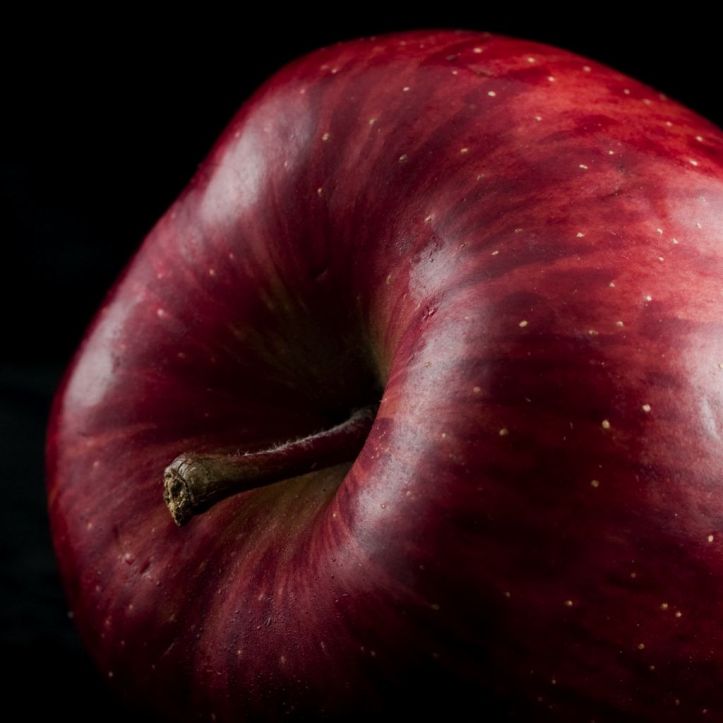
Image: Apple 01 by Larry Jacobsen, CC BY 2.0, via Flickr.com.
 Heart of Flesh Literary Journal