FICTION
The Bridge
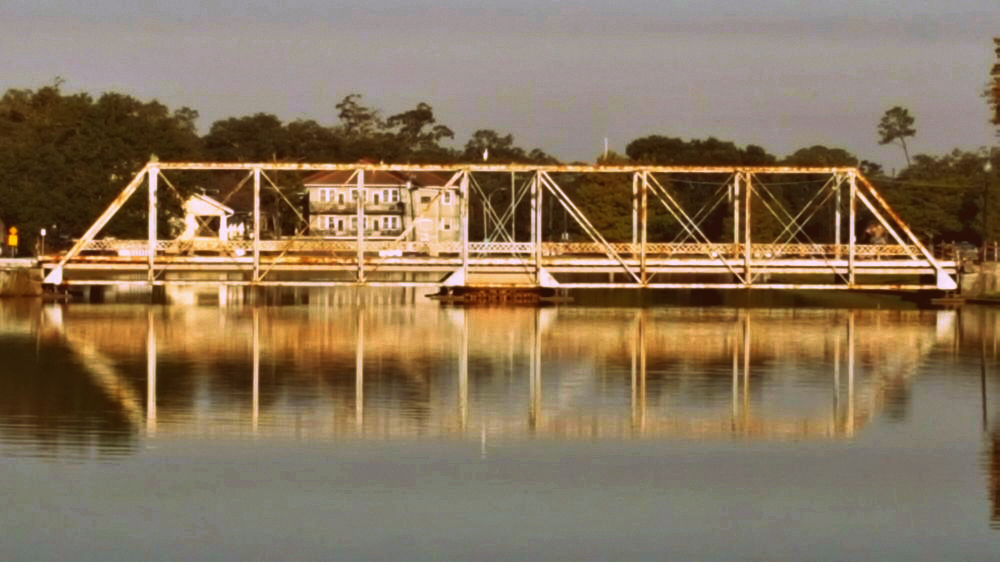
Only Carmen knew that Janelle sometimes hung by her knees from the bridge over Bayou St. John. Cars used it in those days, but it was mainly a pedestrian bridge. It was the same color grey as a sycamore’s trunk, and it sat low to the water, which in that part of the bayou, where it curved, was almost always still, and Janelle liked to hang from it and look down into the water, seeing first her own reflection and then, as she gazed, seeing also the reflection of the bridge in the sky and the longest limbs of the oak trees stretching from the banks and the long hydrilla fronds standing languid and serene below the water’s surface and the whole reflected world.
Carmen and Janelle grew up next door to each other on Bienville, though they didn’t meet, really, until they started together at the Cabrini girls’ school in first grade. Janelle sat across from Carmen at lunch on the first day of school. They shared a bunch of red grapes and a shrimp salad sandwich Janelle’s mother had brought home from the seafood market on Carrollton, where she worked. And after that, they were more or less together, all the way to school and through the day and back, though at home they might as well still not have known each other. Their parents weren’t on speaking terms. This was strange for New Orleans, and Janelle didn’t understand it except that she’d heard her mother crying once, saying Carmen’s mother’s name behind a locked bedroom door, saying, “With Lizette? With Lizette?” And after that, Janelle’s father was gone, and the house itself seemed to relax, but her mother didn’t speak to Carmen’s mother or to her father, who seemed very sad even when he smiled at Carmen as she came home.
One day, Carmen wasn’t talking. Janelle was used to not talking. Her mother went through long periods of not talking, alternating with long periods of talking, not directed to her as to a child but rather as to an audience who might be in the seats of some theater to benefit from a discourse on the vicissitudes of life and their ineluctability. So she was used to not talking as a general rule, and noticed Carmen’s silence and accepted it and wondered at it. It lasted over the bridge to school and through the day and back to the foot of the bridge before Janelle had had enough. She stopped walking. Carmen plodded on, head down and tipping side to side in the loose-jointed way of little children.
“Hey,” Janelle said.
Carmen kept walking.
“Hey,” she said again, this time with a shade of the rage she’d heard sometimes in her mother’s soliloquies.
Carmen turned.
“Come here,” she said. “I wanna show you something.”
Carmen came back, and Janelle took her lunch box and set it beside her own at the side of the bridge and took her hand and led her down into the grass that was a coarse crisp grey then at the end of October and then led her out, edging along the bridge’s substructure, with both hands sliding along the dusty edge of the road, to the joint of the first piling. There had been no rain and there was no current but a cool breeze riffled the surface in places and the light was golden and touched the water and the grass and the bridge with gold and the bells of Holy Rosary rang 3:30 as Janelle sat on the substructure and let herself down, unfolding backwards, till her hair in its thick rough curls cascaded toward the water and her hands reached for the surface nearly touching their own reflections. And she found Carmen’s eyes in the water as it stilled. Carmen was standing, holding to the bridge with one hand and leaning out to look at her friend’s reflection and her own. Then Janelle looked up at her, and they both smiled, and Carmen lowered herself, smoothing her skirt to pin it behind her knees, and hung beside Janelle. The two watched the gold of the day deepen and begin to die. And if Carmen was still silent now, her silence could be shared.
So Carmen was the only one who knew, or that at least was what Janelle thought, and that the two of them might now share the secret arterial joy of the sky that gathered a foot away on the water’s face and the silent world that floated and finned and languorously grew beneath it.
That was Friday.
On Monday, the 2nd of November, Sr. Miriam Clare led her second graders back from Mass. Once they were seated, Sister stood before them, hands clasped at her belly in a gesture not of prayer but of serene command.
“Girls,” she said, “my good girls. It is a day to recall that not all souls will know the blessedness for which they are made. Christ the vine bids us be all grafted into him. But finding the sap too bitter in the early draughts, some draw away and wither. How hard the way, and how much the harder when in childhood we’ve not begun to learn it, to make its steps and strictures our own. Christ is the bridge, children. Christ is the bridge. Stay with him. Keep your feet to him. And do not tempt the deep below.”
At those final sentences, Janelle lifted her eyes to Sister’s and waited. Her gaze was not returned, though she imagined this was by design, that every blink and slip of eye was calculated to leave her alone in her supposing. She felt, too, the urge to look at Carmen and resisted even after Sister turned to the board and began to write. But she could feel Carmen looking at her, and she put her head down until the click and rasp of the chalk came to an end.
At lunch, the girls sat across from each other, as they always did, at the end of their usual table. And Carmen said, as she flipped the latch on her lunchbox, “Do you think she saw?”
“Who?” Janelle said.
“Us. Sister. On the bridge.”
“Oh,” Janelle said, biting a fig. “No.”
“But she said stay on the bridge.”
“She’s just being preachy. She didn’t mean nothing by it.”
“I don’t know.”
“I do.”
“But why would she talk about the bridge the very next day?”
By then, Janelle, not knowing why, was feeling mean about it, so she said, “You know I think your mama’s gone pretty far off the bridge a time or two.”
She didn’t even know exactly what she was saying but she knew its enormity as she said it and saw it too in Carmen’s eyes, which stared over the pink shoulder of her apple until it came down and rested on the table and Carmen said, her voice steady even though her hand was trembling, “Well at least my mama’s still at home.” And she stood and gathered her apple and her lunchbox and turned away, leaving Janelle to a brown pear.
So there was silence again, silence now spined and bitter and bellowing. When the bell rang at the end of the day, Janelle remained seated as the other girls rose, watching Carmen out of sight from the corner of her eye. Then she, too, rose and came behind, slowly, slowly. Glancing up from time to time, she made, downcast, for home. She was over the bridge before she realized Carmen was there, standing in the grass, down by the water, watching her. Both were still for a moment.
“What do you want?” Janelle said.
“I bet you won’t try it again,” Carmen said.
“Try what?”
Carmen pointed to the bridge. “You know Sister was talking about us. Admit it.”
“You’re crazy,” Janelle said.
“Go on and do it,” Carmen said.
“I don’t feel like it.”
“You’re a liar and a coward then.”
For an answer, Janelle climbed out and let herself hang. At first, she watched Carmen, who was not looking at her but seemed rather to be staring off across the water to the far end of the bridge. Then she let her sight drift to the water below. Now she was seeing the water itself, now the sky that lay along it, now a bluegill gliding by with fins the blue of stove flame, now herself as if about to fall through the sky to the water beyond. And then, like a great fish swimming up to swallow her, rose the veiled face of Sr. Miriam Clare. Janelle looked up. The eyes that met hers were stern and bright and sorrowful.
“Oh, Janelle. Oh, Janelle.”
Janelle looked to the bank, but Carmen was gone. She clambered up and edged along the bridge, wondering if she ought to run. But Sister was there to meet her at the water’s edge and snatched her to herself and held her at arm’s length, kneeling before her on the grass.
The two walked in silence to Janelle’s house, and inside, declining a cup of coffee, Sister told Janelle’s mother what had happened and that she felt, given the seriousness of the matter, that there was no choice but to suspend Janelle for two days. Janelle’s mother was gracious and superb, and when she had bid Sister farewell and shut the door, she went a long while in silence. Then she began to laugh. And she laughed for a long time and began to speak of the foolishness of it all and the endurance of fools and the miserable foolery of women with women in the woeful world, and Janelle listened for a long time until, certain of her own foolishness and the foolishness of it all, she felt her heart subside into silence and the wish that a friend were there to share it.
The next day, her mother went to work at the seafood market, and Janelle sat alone at the window watching her go and watching Carmen on her way to school, and watching Carmen’s father walk sadly down to his car and hunch over the wheel and drive away. A deep listlessness settled on her, a sadness that nursed itself so that she grew jealous as she thought of Carmen’s mother sitting alone as well next door. Then a shiny blue Continental pulled up to Carmen’s house, and Janelle was sick and somehow a little glad to see her father get out and stroll with his hands in his pockets and his same old close-lipped smile up the walk to Carmen’s door. So she was alone again in her loneliness and was glad for an hour until her father went away again, strolling at his ease, his head looking up and down the street, his lips pursed in a silent whistle.
Around noon, she ate an apple. She tried to fix a sandwich, but instead took the two slices of bread and walked down to the bayou. She sat on the bank as the Angelus died in the tower across the water and balled up bits of the bread between her finger and thumb and threw them on the surface and watched the bluegill swirl and peck. A mallard pair paddled near, dabbling up the bread, and a turtle, peering from midwater, rowed to join them. The bread ran out, and the water grew still, and Janelle looked across the water a while and turned for home.
At half past three, she was at the window in the living room again. She hadn’t turned a light on all day. Carmen came up the street and turned in at Janelle’s walk. She stood at the door, then looked over at the window, her eyes falling exactly on Janelle’s though Janelle was sure she couldn’t see her. The mail slot clattered, and Carmen dropped from the front step and darted across the grass for home.
The note on the mat said, You missed a quiz today. Sister looked sad. Sorry I called you a liar. And a coward. Carmen.
Her mother came home smelling of shrimp, and they had étouffée for dinner. Janelle did not say she’d seen her father. Her mother put extra butter on Janelle’s rounds of French bread.
The next day, Janelle did not sit at the window but waited till the church bells tolled eight o’clock and went out to walk the neighborhood. She was afraid to let the day pass into sameness with the last and afraid even more so to see her father again, and almost thought she saw his car turning onto Bienville as she glanced back from the corner of Cortez. But she hurried on and came before long to City Park and lay for a time beneath the huge sprawling oak she called Moses and watched the Spanish moss curl and sway against the clean, cold blue of the sky. She ran around Bayou Metairie and stopped to skip clam shells she dug from the bank and landed one in the hollow between a swimming duck’s white wings and stopped and watched it swim away with something like the feeling of prayer as it had come to her sometimes in the school chapel.
She had a nickel she’d been saving from the last time her father had come to see her, and she gave it to the man at the counter of the old casino building near the art museum, and he gave her back three pennies and a hot dog, and she sat on an oak root listening to a man play the saxophone while she ate.
Inside the museum, she stood before St. Francis by El Greco, whose name she recognized almost before she read it on the nameplate, since her mother kept a copy of his Vision of St. John in the living room. Once she’d asked her mother why the people looked like trees, and her mother had said, “It’s a style, baby, it shows how people’s souls are always stretching up to heaven.” So she knew the name, and the saint, like so many saints, frightened her. But across the gallery was a St. Sebastian by somebody she forgot as soon as she stepped back from the nameplate, and he was beautiful, and he did not frighten her as she stood between the two men. St. Francis looked out from a gulf of darkness, and his eyes shone with tiny white flames like skulls, and St. Sebastian was pierced in the side and in the belly, but the arrows’ bites were bloodless as if barred their lust and she wondered, looking from one to the other, how many souls there were with her in that long red gallery.
At three o’clock, she left the museum, taking the steps slowly, already mourning the day. The bells called out down a line of naked crape myrtles that she followed to the bayou. She could see the bridge in the distance with a line of girls in their blue uniforms crossing for home, and she imagined for a moment that the bridge was the torso of a monumental figure, pierced, with all the water of sorrow flowing through it and away and the girls walking safely, mounting ever higher through the mannered elongation of the oaks into the skull’s eye of the sun and endless light. Then she hurried along the bank and came to the bridge, where Sr. Miriam Clare stood talking at the center with Carmen.
“Hello, Janelle,” said Sister. “We were just talking about you.”
“Hello,” she said.
“Hi,” said Carmen.
“We’ve missed you, dear girl,” said Sister. “But we’ll see you again in the morning. Carmen will help catch you up.”
“Thank you,” Janelle said. “Thank you.”
“Well,” Sister said. “Good evening, girls. God bless you.”
She turned and walked through the frame of the bridge, her veil rising slightly behind her on the breeze. The girls watched her go, then stepped to the edge of the bridge and looked over and found each other on the water’s face.
“Well,” Janelle said to the reflection, “do you wanna come to my house?”
The eyes in the water vanished, and Janelle turned and found Carmen looking at her, smiling, nodding her head. And Janelle saw her friend and saw herself being seen and thought, almost, that she could see the rest of their world in Carmen’s eyes as well, the bridge and Sister and the school and the dome of the church. Then hand in hand they walked away, the breeze at their backs, sharing what had passed in silence.
Daniel Fitzpatrick is the editor of Joie de Vivre and the author of Restoring the Lord’s Day (Sophia, 2024), First Make Mad: A Novel (Cascade, 2024), and Yonder in the Sun: Poems (En Route, 2024).
Next (Susan Piper) >
< Previous (Mark Paalman)
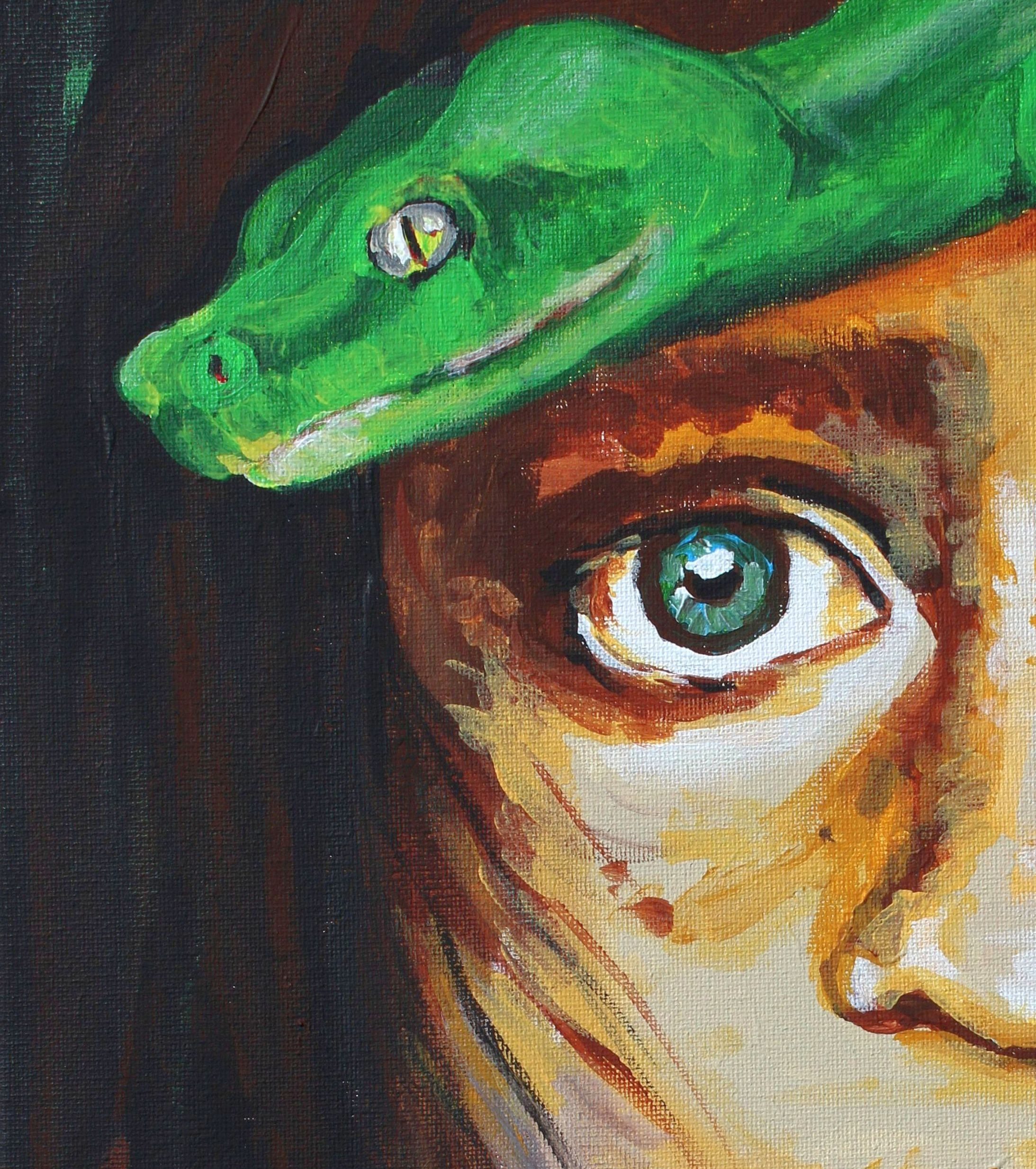
Image is in the Public Domain. Modified by Veronica McDonald.
 Heart of Flesh Literary Journal
Daniel, I thoroughly enjoyed this story, and love your sumptuous sentences. It felt rooted in the Southern Gothic tradition. I’m grateful that we are HOFLJ neighbors! -Mark
LikeLike