NONFICTION
In the Tomb of San Francesco
(A Memory From 1996)
I was amazed there wasn’t more of a line to go down there. I mean, he’s such a popular guy. I believe there were more people going to see Santa Chiara, but perhaps that’s because her body never decayed and they show it off every twenty minutes or so. The wax they’ve put on her face, to keep the skin perfect, has turned a sort of ghastly green, so I can imagine why people want to see her more than Frank. After all, Frank decayed, and now what’s left of his bones is housed in a little stone box underneath his basilica.
I walked down his stairs and took note of everything. Though they’ve fitted the place out with electricity, it wouldn’t have surprised me to see torches lining the walls. It certainly was the kind of place I’ve imagined for every D&D adventure I’ve ever taken. The steps curled into darkness, a place hollowed out of solid rock under the basilica. Truth is, this little cave is the reason the big church was even built. Now it’s dressed like a sort of chapel.
There’s a large, dark, antechamber before the tomb itself. The two rooms are partitioned by a metal grate, floor to ceiling, with a small door frame at its center. The antechamber is filled with candles, yet there are bright electric lights shining down on the tomb. Those lights are well hidden; I never saw them.
The floor is a large stone slab, cut to look as if several rectangles of stone were dropped into place. Mousey gray dust covered everything and muffled the shuffling footsteps of pilgrims. I walked up the middle, between rows of pilgrims whispering foreign prayers over their beads.
Each pilgrim bent a little further over their pew the closer I got to the tomb. The urge to kneel and pray was strong, but I wanted to get a good view of things before I did.
There was a man genuflecting repeatedly before a roughly hewn altar, carved from the same stone column that holds Frank’s remains. The column itself is about eight feet tall and about five feet wide. With careful observation, one can see that the whole tomb was carved out of bedrock within the hills of Assisi. The stone box of Frank’s remains, set in an alcove above the altar, is three feet long and about two feet wide. It too is roughly hewn, though there are four delicately curved feet jutting out of its base.
The man continues genuflecting while I stare at the alcove above him. I’ve been told that the box is so small because there’s only some ribs, a femur, small parts of Frank’s skull, and part of his upper arm that has not yet decayed. Hard to believe that a man who so changed the way Catholicism is practiced, who invented the concept of the Nativity scenes that are now commonplace at Christmas, has been reduced to this. But then, I imagine this is exactly as it should be. After all, Frank was fond of calling himself Brother Ass.
I’m amazed by the dedication it took to carve this. Along the walls around the column are gifts that pilgrims have left behind: old wooden crutches, rusting rosaries, war medals, and letters in strange, faded handwriting. On the other side, a priest sells candles for a couple thousand Lire apiece. They’re the long white wax variety, the kind that start to bend one direction or another as soon as you hold them. I bought one and took it to the candle rack on the other side of the column. There, between half a dozen other melted candles, I left my light to seep down the edges of the black ironwork.
I wandered back to the pews in the antechamber and took my place among the whispering souls. For the first time in my life, I had no idea what to pray for. That trip was a dream come true for me; I must have been overwhelmed in the moment. For all the grandeur of the upper and lower portions of the Basilica di San Francesco, I was really moved by the simplicity of the tomb. There wasn’t even a painting, nothing but candles and the great column in the middle of the room.
I looked around at the people who were praying, tried to guess what parts of the world they were from. The guy who had been genuflecting at the altar was bowed over the pew in front of me, two rosaries going at once. It seemed comical, but that’s the essence of devotion I suppose. I imagine that sort of wild abandon is what led Frank to do his own thing. Frank has always been my hero; he just sort of plowed through life no matter what, and I admire that. The only thing I could think to do in the moment was kneel and thank my patron for helping me finally get to Assisi. I knew if I prayed thank-yous long enough, I’d be moved to some real prayer.
Trouble is, I didn’t get that far. After I bowed my head, I became aware of a low hum. I hadn’t heard it the whole time, so I looked around to see if something was going on, but there were the same five pilgrims I saw praying moments before. So, I went back to praying, but the hum persisted. It was like a low vibration, sort of like electricity flowing through an electric fence or the sound a battery charger makes when the car battery is running low voltage.
I kept praying, and the hum just seemed to fit after a while; it helped me center. I’d like to think the hum came from the stone box that held Frank, but then I’d seem the freak, wouldn’t I? Well, I won’t go so far as to say it was Frank himself, but I know there must have been something about the tomb that made the hum. Maybe it was just great acoustics, or perhaps the echo of people whispering behind the column. I’ve stopped trying to put a reason to it, because it’s nicer to just remember the hum and the peace I felt while praying — even though it didn’t really make me pray any better, just sort of a good meditating experience.
After about fifteen minutes, I got up and left. The sun outside just about blinded me, and everything was much louder after the quiet of the tomb. I went back about four times during my stay; the hum became more commonplace each time. Now, as the memories are just a glow in the periphery of my experience, the hum is the only thing that remains. I won’t say it makes me pray any better or that I’ve been healed by it or anything like that. But on some cold nights, chattering beneath my cotton blankets, the hum is enough to lull me to sleep. The dreams of olive tree hillsides in Assisi have continued to be a friend to me the farther I get from the pilgrimage.
Steve Bowman’s work has appeared in Amarillo Bay, The Zen Space, Last Leaves, Southern Arizona Press, and Wicked Shadow Press. His writing centers on spirituality or otherness found in the mundane. When not writing, Bowman seeks inspiration with his little dog, Grummle, in the leaves and hills of Southern Indiana.
Next (Marcia N. Lynch) >
< Previous (John S. Walsh)
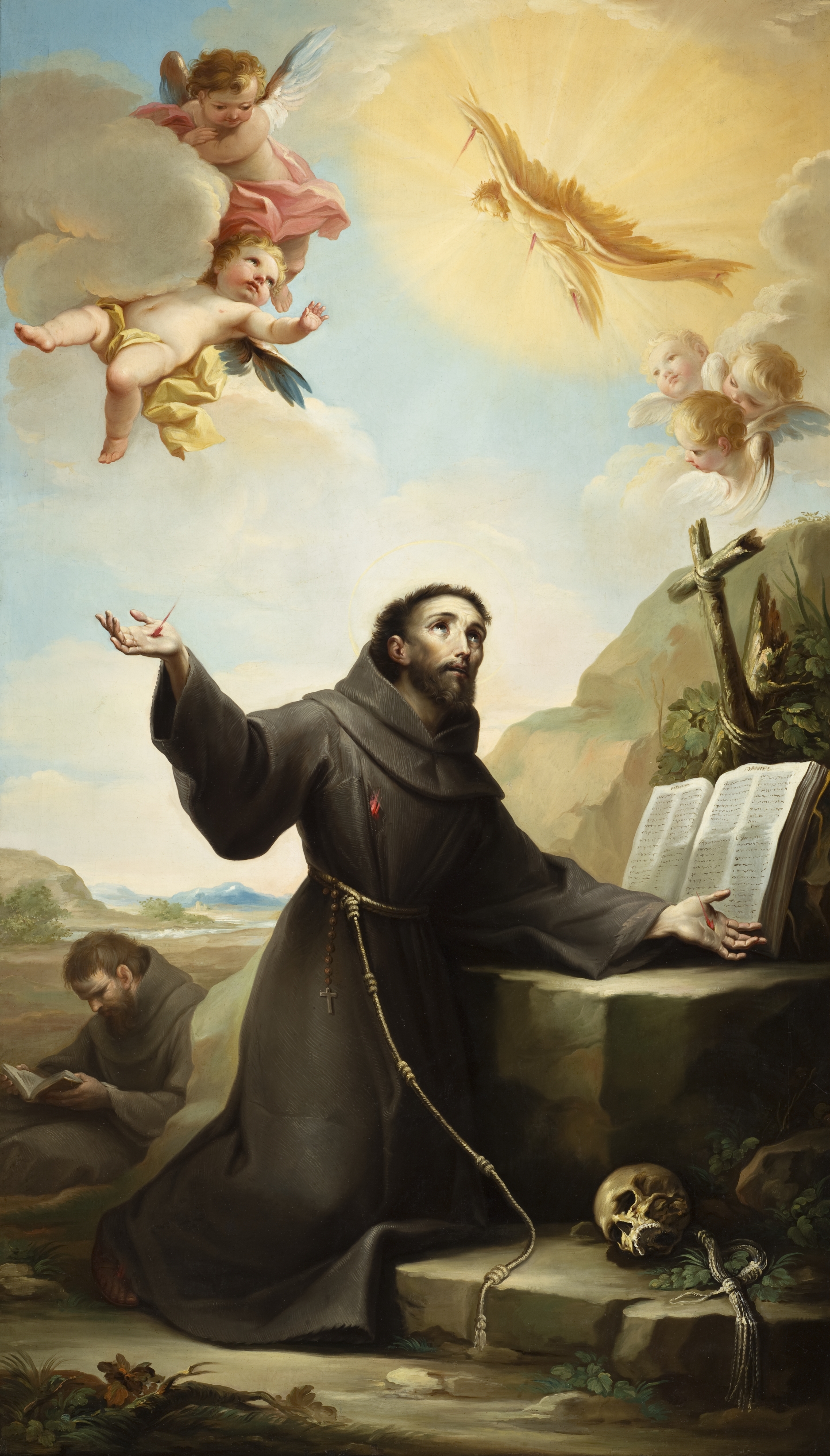
Image: Saint Francis of Assisi Receiving the Stigmata by Mariano Salvador Maella, Public Domain.
 Heart of Flesh Literary Journal