FICTION
Simulation Study
SUNDAY, 6:38 PM
“There,” Andy said.
They stood on the catwalk above Tank 167 in ChemSynCo’s Churchill Island Industrial Facility. Below the thick plastic seal under their feet, a tiny clay island rose out of thousands of tons of water. A tube near the top shot a steady stream of what looked like sparks into the water. The water was turning red near the edges of the tank.
“Okay. It’s a tank,” Celia said. Celia was Andy’s fiancée. “I’m very impressed.”
“It’s not just any tank. It’s a Grand Synthesis Experiment. My Grand Synthesis Experiment.”
“I thought you said your advisor turned down a GSE.”
“They didn’t think they could get the funding. I told them my brother’s a Director of ChemSynCo, but they weren’t listening. Now they’ll have to listen.”
“Darn it, Andrew, you’re letting your fool pride run away again. If your professors thought it was a bad idea, you should have accepted it and done something else.”
“A GSE will work, Celia.”
“It won’t work — because life cannot arise from non-life. Life requires a directing intelligence to form it.”
“I don’t understand how a person like you, with a scientific education, can accept the kind of crap coming out of the Discovery Institute.”
“Watch your language, Andrew. I accept it because I’m a Bible-believing Christian.”
“I’m a Christian myself, Celia. Advanced life evolved from primitive life, primitive life from chemicals, and the Earth is 4.55 billion years old. None of that contradicts Christianity.”
“Maybe not watered-down, liberal Christianity, like you believe in, but I’m an old-fashioned evangelical, Andrew. I know the Earth is 6,000 years old and that God made Man from the dust of the Earth. And you won’t prove a darn thing with your chemicals in a tube.”
“You claim to want to be a scientist, Celia.”
“Yes. A biochemist.”
“You believe in the scientific method.”
“I wouldn’t say believe in.” Her tone was wary.
“Then if life forms in that tank down there, you’ll have to accept that God created a universe where life would arise automatically under certain conditions.”
Celia turned away from him. “There could be contamination.”
“If there isn’t? If I can prove to your satisfaction that the experiment was well-planned and had no contamination?”
“I am not listening to this, I am not listening to this, I am not listening to this!” She clamped her hands over her ears and hurried out of the room.
***
MONDAY, 10:41 PM
Dr. Hirota, Andy’s advisor, looked down on the tank from the catwalk. The water had a pronounced red cast to it. A bubbly, orange scum had collected on much of the island. Dr. Hirota was Shisei, a fourth-generation American, but because her family happened to be short, she matched the Western stereotype of the tiny Asian. The contrast between her and the tall, thin grad student was marked. Yet both had the same look of concentration.
“The island. I assume montmorillonite clays?”
“Yes. Thirteen tons.”
“Why a spark generator? Some kind of tribute to Urey-Miller?”
“It’s a micrometeorite simulator. It fires sterilized iron pellets at meteorite speeds.”
“So you have shock waves instead of sparks. You think that will be sufficient?”
“Yes. I have UV irradiation too; those are the purple lights. Destructive long-wave UV, just like on the early Earth.”
“You remember what Thaxton said about the stability of complex molecules under UV irradiation —”
“Thaxton et al. 1984, page 47,” Andy recited. “Optimism regarding possible shock-wave synthesis should be tempered by what we shall call the ‘Concerto Effect.’ … Amino acids produced in the atmosphere by electrical discharges or shock waves … would be vulnerable to long-wavelength … ultraviolet photodissociation.”
“Your reply?”
“Miller et al. 1976 cite 3,359 calories per square centimeter per year for long-wave UV, 1.1 for shock waves. But Bar-Nun et al. 1970 say shock waves are one million times more efficient than short-wave UV at promoting synthesis. Even under long-wave UV, synthesis should dominate over dissociation by a factor of 327. Thaxton et al. were being qualitative where they should have been quantitative.”
“You’re sure?” his advisor asked sharply. “You’ve made a mathematical analysis?”
Andy handed her a sheaf of computer printout.
“I’ll review this later,” she said. She turned back to watch the churning water.
Andy watched her.
“I don’t think it will work,” she said after a while. “You’ve got a tiny, tiny volume to work with here instead of the whole ocean, and a tiny amount of time instead of several hundred million years. I don’t think you’ll succeed in creating life in the lab.”
Andy said stiffly, “Are you telling me to abandon the experiment?”
“That was my first thought,” Dr. Hirota said. “I don’t like smart-ass grad students thumbing their noses at me. Neither does the rest of the committee.”
Andy flushed.
“But if you even succeed in creating a good mess of polymers, it’ll throw a monkey wrench into Thaxton’s spokes. We’d all like to see that happen. Goddam creationists.” She smiled, watching the sparks shoot into the water.
“Why, Hirota-sensei, you almost sounded human for a minute there.”
“Don’t kid yourself, wiseass. I am a superior being. I got the sheepskin, you don’t.”
“I’ll have it soon.”
“Yes,” she said. “You probably will.”
***
TUESDAY, 3:50 PM
The three members of Andy’s committee stood in the interface room with Andy and Celia.
One wall was an enormous window of thick plastic. Most of the view was the green blur beneath the surface of the water, but above that they could see the island.
Purple needle-shapes stood up like hair on the mound of clay.
“I believe they’re photosynthetic macroorganisms,” Andy said.
“Don’t jump to conclusions!” Dr. Hansen said. Hansen was white-haired and elderly, and looked extremely frail. His booming voice was always a surprise, even to those who knew him. “You haven’t even found microbes yet, and the chance of plants evolving so soon is almost nil. There was no land life at all till four billion years had passed. Don’t be in such a hurry to grasp at the melodramatic. It’s enough that they’re complicated chemical structures of some kind.”
“That’s why I called you all down here,” Andy said. “I have found microorganisms!” He handed Hansen a microscope slide.
“Despite rumors, I haven’t got microscope eyes.”
Dr. Hirota suppressed a laugh. Dr. Zelinski, the third committee member, smiled.
“Over there, sir.” Andy pointed to a multi-lens Bausch and Lomb photomicroscope.
Hansen went over to it and switched it on; he selected a lens, and adjusted the focus. “Ring-shaped, non-nucleated, size about 200 microns. Almost transparent. I assume gram-negative?”
“Yes, sir, it doesn’t react to any of the standard stains.”
“This could be contamination, you realize. Either a previously undescribed Earth organism, or the pathological remains of a known one after it went through that sitz bath of yours.”
“I’ve done an electron microscope search for ultra-structure,” Andy said. “I’ve also partially sequenced what seemed to be nuclear material. It’s double-stranded, something like DNA, but it isn’t DNA. It’s got uracil in place of thymine. A previously unknown genetic material.”
“You’re jumping to conclusions again. Aminos?”
“Glycine and sarcosine dominate.”
“That implies decay.”
“No, sir. Aside from the glycine, they are uniformly dextro-rotatory.”
“Jesus,” Hirota said.
“It can’t be that easy,” Dr. Zelinski said. “People would have been creating life for a long time now.”
“If they had 20 million dollars of ChemSynCo equipment and exactly the right design available,” Andy said dryly.
“I don’t believe it,” Celia said. “I just don’t.”
“Why is that, Miss Annandorf?” Dr. Hansen asked.
“The Universe was created 6,000 years ago, and life was breathed into being by the Lord God. I don’t believe some godless scientists can create life in a tank. I just don’t!”
No one spoke for a moment.
“Well, perhaps we are using means God created for us,” Dr. Hansen said. “I agree with you, Miss Annandorf, that there is something transcendental out there. The Heisenberg Principle showed us back in the 1920s that there were things about the Universe we were never going to know, no matter how good we got at science. But it isn’t necessary to take every Biblical passage literally.”
“It is for me, Doctor,” she said. “I am a Christian. I believe in literal inerrancy.”
“I am a Christian,” Andy said. “And I don’t.”
“Then you’re not a Christian.”
“Oh no, you don’t! You’re doing just what Jesus condemned in Mark 7:7 and Matthew 15:9 — ‘In vain do they worship me, teaching for doctrines the commandments of men.’ You and the Discovery Institute have set up an eleventh commandment: Thou shalt not believe in evolution — and demanded that everybody believe it. That’s not just pseudo-science, it’s blasphemy. It’s putting yourself in the place of God.”
For a moment, Celia was silent. Then, slowly, deliberately, she took the thin golden ring off her finger and plunked it down on a lab table.
“Oh, Jesus,” Andy said. “Celia, I didn’t mean —“
But she was already leaving the room.
“Celia!” The door shut behind her.
Silence again.
“You can’t win an argument like that,” Dr. Hansen said. “This is my fault, for starting it. Andy, if you want to go after her, we’ll wait. We can continue this another time.”
Andy shook his head. “We’ll make it up later. I want to retrieve a sample from the surface of the island. Those plant-like objects.” He went to the control panel for the remote manipulators. No one spoke while he maneuvered the robot arms.
***
WEDNESDAY, 9:06 AM
Andy sat at the control panel. He hadn’t bothered to shave that morning. Beside the laptop computer he was furiously typing at, lay an empty foil tray with one pecan roll left and a small bottle of Gatorade.
The door opened. Celia walked in, wearing a blue raincoat and hat. Andy saw her and stood up, wanting to embrace her. She moved around him and went to a square plastic tray with small purple needles in it.
“Celia … Thank you for coming back … I, uh, I didn’t mean to get so —”
“Are these plants?” she asked.
“Yes, I think so. They’ve got two different variants of chlorophyll in them.”
“It freshens your breath,” she said. Before Andy could stop her, she picked up one of the tiny purple objects and gulped it down.
“Celia, spit it out!”
“Why? You can spare one, can’t you?”
“But it’s an alien biochemistry! Jesus, Celia, there’s hydrogen cyanide out there! Formaldehyde! Please spit it out!”
“Too late. Already swallowed it.”
“Will you let me take you to the ER?”
“I feel fine, Andy.”
For a moment he was at a loss. Then: “Why did you come back here, Celia?”
She took off the hat and faced him. “My parents made me. I told them you were becoming a secular humanist, and I thought they’d agree with me that it was best to break it off. But they thought I should give you one more chance. I guess they like you, Andrew.”
“Well, I like them, too.”
“Nobody cares about what’s right anymore. Just me. Even my parents, who always raised me to do what was right no matter what. Daddy with his strap. And even he turns out to be a hypocrite.”
“Jesus, I hate when parents do that. He hit you with a strap?”
“You take the Lord’s name in vain a lot, don’t you?” She nodded. “He only strapped me when I was little and did something really bad. After that I learned not to be bad. He was really a very good father, Andrew. I’m sorry he’s damned.”
“Huh?” Celia had always spoken adoringly of her parents. “Celia, are you all right? You’re acting, I don’t know, downright weird —”
“The plants will not hurt me, Andrew Henderson. Because God will not allow anything bad to happen to his Elect.”
“Celia … I’ve always been a free-will freak. But even Calvin said you never know who’s Elect and who isn’t. He sometimes acted like he knew, but he apologized to his congregation for it.”
“Martin Luther said, ‘Do you doubt that you are saved? Then say your prayers, and you may conclude that you are.'” Suddenly she bent her head and held her hands together. “Our father, who art in heaven, hallowed be thy name …”
Andy said it with her. When they were done, she looked into the tank. “What are those?” she said.
A miniature tree had sprouted on the island, dark, wet brown in color, with cherry-sized red globules hanging down from its branches.
“Well, they look like fruits, but I think the plant’s really something like a fungus, and those things are spores. Fruit trees didn’t appear until very late in Earth’s history.”
“They were created on the third day,” she said. “But I see you’re still clinging to your humanism. I’ll change your mind, sooner or later. Get me one of those fruits.”
“Huh? Why?”
“To eat, of course.”
“NO!” Andy said.
“Andy, don’t yell like that. You frighten me.”
“Good, I meant to,” he said. “Let’s get something straight, shall we? There is a diverse set of poisons out there, and I can’t think of any quicker way to kill yourself than by trying to eat a large object from that environment. Do I have to remind you suicide is a sin? Look!” He swung around to the control panel and punched for a “sea” sample. A small box extended into the tank, made a sucking sound, came back. A small thump as a door opened.
Andy reached in for the small vial of fluid. He twisted off the cap and held it in front of Celia’s face. “Does it smell good?” he demanded.
The smell was as rich and foul as dog feces. Celia recoiled.
“The fruits, if they are fruits, are probably the same way. Promise me you’ll stay away from them. Look, Celia. I know you can work these controls. Promise me you won’t try to eat one of those fruits, even when I’m not here. You’ll die if you do.”
“I promise,” she said in a small voice.
He felt guilty and tried to pat her shoulder, but she evaded him again and slipped out of the room.
***
THURSDAY, 2:07 PM
Dr. Hansen and Dr. Hirota stared in fascinated horror. Tiny black creatures like bat-winged grasshoppers whirred and fluttered over the island. Nearby, a brown worm several inches long crawled over the window surface with purple legs. Red, feathered antennae like those of a moth brushed the plastic in front of it.
“I would say this was impossible if I weren’t seeing it,” Dr. Hansen said. “On Earth, there were no macroorganisms until 700 million years ago, by which time the Earth was already 3.8 billion years old. And nothing on land till 430 million years ago, due to the high UV flux before the ozone layer formed.”
“Or no macroorganisms were preserved,” Dr. Hirota said. “Maybe it was only hard body parts capable of being fossilized that arose in the Cambrian.”
“I guess there must be some explanation like that. See here, Andrew, are you recording all this?”
“Video, audio, and specimens,” Andy said.
“When the press finds out, you’re going to be famous. This is bigger than Urey-Miller. The Creationists will be screaming fraud, but this is the ultimate answer to their ravings. Life isn’t hard to create, it’s easy!”
He turned around suddenly to face Andy.
“And don’t get smug, young man. We intend to grade this dissertation like we would any other. The fact that it has had glamorous results is neither here nor there. I want clear writing, good logic, citations in proper order, figures and tables appropriate to the discussion.”
“You’ll have them,” Andy said.
“In other words,” Dr. Hirota said, “He’s trying to decide whether to give you an A or an A+. If you want that plus-sign, you’re going to have to work for it.”
“Really, Ruth. You don’t have to undermine me.”
“I’m not. Andy’s thesis will be in order. You’ll see.”
***
FRIDAY, 7:37 AM
Andy stared at the interface window, his mouth hanging open. A brown animal a foot long lay on the island. It looked somewhat like a six-legged cow, and somewhat like a furless cat or weasel. It sat in a copse of purple vegetation. Tiny black miniatures of it nursed busily at its underside.
“What did it evolve from?” he asked. There didn’t seem to be any precursor species. Nor were there any other large animals on the tiny island.
***
SATURDAY, 5:50 AM
“Oh, no,” Andy said on the catwalk. “Oh no, oh no. God damn it, Celia, how could you do this to me?” He knelt on the catwalk with his fists and teeth clenched tight. “God damn it, God damn it, God damn it!”
Celia had piled all her clothes on the catwalk and cracked the main seal that led down into the simulation tank. She sat on the island now, kneeling naked at the tiny tree, eating the tiny red fruits.
Andrew moaned. Clearly she was having some kind of breakdown.
Hysterical Personality Disorder, his mind supplied suddenly. And you’ve been chip, chip, chipping away at her defenses. Good going! You bloody fool!
It could be something worse. Schizophrenia usually hit in adolescence, but it wasn’t unknown at college age. At least the experiment had gone far enough to guarantee Andy his Ph.D. And now that he knew the method, he could always start over again.
First things first. Go help Celia.
It’s okay to help Celia now that you know your career is safe. First things first, as you said. Right?
Shut up.
He started to descend the ladder, then stopped. He stripped off everything but underwear, since he would have to swim to the island and there was no sense getting most of his clothing wet. Taking off everything would have been more logical, but he was too inhibited for that.
Down the ladder, the steps slimy with orange ooze. He stepped into the warm soup and jumped in with a splash, then swam forward toward the island. The sea tasted like lab chemicals.
It was a short swim. He pulled himself up, trying not to step on the various worms. Most were dead or dying, poisoned by the oxygen Celia had let in with the outside air. The ones underwater were still twitching, but just barely.
He stood up and sloshed through clayey mud toward Celia. The UV lamps overhead hurt his eyes. He knew he would be badly sunburned later. God knew what Celia’s skin would be like.
He walked up to her. She looked up, her blank eyes and gentle smile, the face of psychosis. Andy hurt inside. “Celia,” he moaned.
She held up a tiny red fruit. “Want one?” she said. “They’re good.”
Slowly, not knowing why he did it, Andy took of the fruit and ate.
Barton Paul Levenson has a degree in physics. Happily married to poet Elizabeth Penrose, he confuses everybody by being both a born-again Christian and a liberal Democrat. His work has appeared in Cricket, Cicada, the New York Review of Science Fiction, and many small press markets.
Next (Chelsea Barnwell) >
< Previous (Kendall Miller)
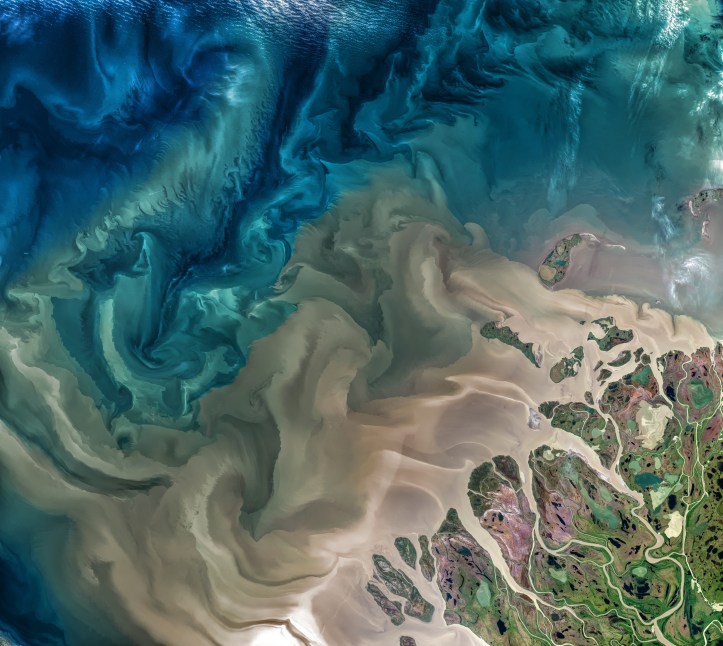
Image: Mackenzie River Outflow. Original public domain image from Wikimedia Commons.
 Heart of Flesh Literary Journal
I have a physics degree too. This was delightful.
LikeLike