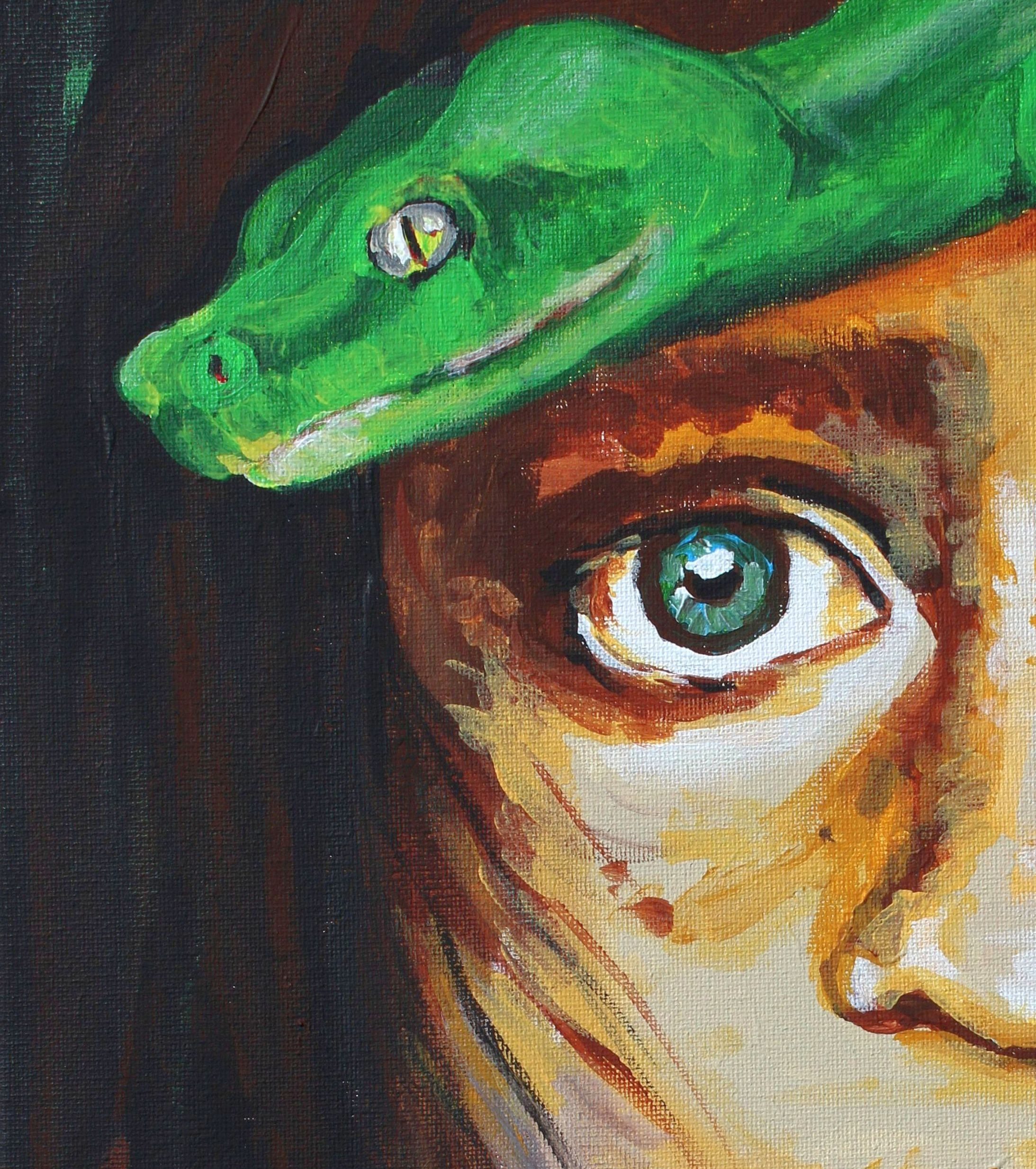
FICTION

All That Is Gold
The sunlight glinted off the golden cottonwood leaves, almost dazzling Charlotte Kennedy’s eyes as she gazed down the wooden bridge. A tremor passed through her, landing in her gut and quivering like the leaves in the wind. And there it stayed as she finally blinked and turned back toward the parking lot, willing her body to do what she both longed and feared to do.
She collected the easel, canvas, and satchel containing oils, palette, pencils, and brushes from her car, old friends accusing her of neglect. Or perhaps they welcomed her touch, grateful to see the sun.
Either way, she needed to view them as friends or else she could never paint another picture.
A woman in a nylon jacket jogged past her onto the bridge. From the other direction a family of three, wearing long sleeves and beanies, strolled toward her. As long as her supplies remained tucked under her arm, Charlotte was incognito, safe. She didn’t look into the faces of the family as they stepped off the final planks of the bridge onto the cement.
Then she was alone at the edge. Revitalized and reinvented as a walk-and-bike trail, the historic wagon bridge that crossed the overflow plain of the Canadian River in the Texas Panhandle stretched farther than the eye could see. Its story was heartening, as all resurrection stories are. The quiver stilled in Charlotte’s stomach.
She unfolded the easel, set the canvas on it, and placed her palette and brushes on the planks. The brown metal rails and towering trusses formed an open tunnel, almost dizzying as they funneled her gaze to the end she couldn’t see. Here, she stood in the shade of a green cottonwood giant, the dazzling gold awaiting her farther down in the sunlight. She needed better light, more gold. Farther she would go.
The late-October sun breathed life into her cold cheeks as the breeze ruffled her hair. Cars whirred past on Highway 60, parallel to the bridge, hidden by trees. Trembling inside but outwardly steady, Charlotte picked up a pencil and held it over the canvas. It didn’t seem possible she should remember how to do this, yet her arm pressed forward and the pencil made thin gray lines appear on the empty whiteness.
Tears blurred her vision. Progress halted. Blinking them back, she pressed on, eyes chilled as another breeze blew sideways at her.
The sketch of the bridge formed before her, but something was off. The lines wobbled; the precise triangles between the trusses were uneven and askew. Doubt crashed through a door, storming into her mind. How did she think she could do this again? And here, the wagon bridge, of all places?
She threw the pencil into the trees, brushed past the easel, and strode down the bridge. She shoved her hands into her hoodie’s pocket, fingers clasping each other for warmth. What a fool. What an impostor. What had she seen in herself to think that she could paint?
The contests she’d entered and never won, the friends who had never encouraged her, the family who had told her she was wasting her time and should focus on her real job. The paintings she had never sold, the job that consumed her hours, the bills that demanded to be paid. Their voices overwhelmed the voices of the teachers who praised her talent and the closest friends who understood her need to create and told her she was good at her passion.
For three years her supplies had lain dormant while she pursued a life that was full yet empty. And during that time, the flickering hope that she would pick them up again had stayed alight. Now, that hope was snuffed out, as if it had been a candle in this wind that shook the cottonwood leaves.
Charlotte’s boots pounded the wooden boards, not quite running, but almost. The lowering sun painted diagonal streaks of light across the bridge. The trees and sky blazed. The metal lamps hanging at intervals from the horizontal trusses gleamed as she swiftly passed beneath them.
She had always wanted to paint the wagon bridge. She’d come here often, sketched it, photographed it, played with colored pencils and watercolor, but before she’d gained the nerve to try an oil painting, she was offered a job she could not turn down. As life grew busier and busier, and her dream to be a professional artist faded farther and farther, even thinking about painting hurt. If she could just forget her dream, she could forget the pain, too.
A small branch in her path snagged her foot. She stumbled and caught herself on the rail, pulse quickening while she stared at the long brown grass and brush underneath the bridge.
Oh, God, she prayed as her heart rate slowed. It’s so beautiful. I just want to capture it, create art from your art. Why does it have to be so hard?
Perhaps she was making it too hard. This bridge outside a small Texas town had been an overlooked ruin not too long ago, and look at it now. All it took was determined people with a vision. Was she really so weak that her determination and vision should fail her?
She turned. She’d made it only about halfway down the bridge, and her easel and canvas, small and forlorn, still stood upright despite the breeze.
Why should she allow others to dictate her definition of success and talent? It might not even be what they actually thought; it was more likely her perception of their perception. Why should she allow those who weren’t invested in her work to impose their views on her? Why give them that power? So what if she never sold a painting, let alone did this as anything other than an avocation? Success, for her, did not need to be in money or acclaim. It was simply creating something she was satisfied with. No. It was simply pouring her all into creating. Because that was what she was created to do.
The canvas, her materials, and the scene before her were the only things that existed for the next uncountable moments. When she finished the sketch with a new pencil, it barely satisfied her, but it was only the skeleton. She squeezed and mixed paint, using a pale brown for the underpainting of the bridge first, then a pale green for the background of trees, then a brilliant light blue for the sky. She worked quickly. She could hardly wait for the cottonwood gold.
The colors teemed on the canvas. Life glowed. As Charlotte painted, she dreamed. Dreamed as she hadn’t for years. The future looked promising. She was still in her twenties — decades of life still to come. She was earning good money, money she could invest in an art career.
If she even still craved that definition of success. Maybe her art was meant only for her. Even with that limited compass, it benefited the world, making her a better, more whole person.
“That’s beautiful.”
Charlotte jumped. Thankfully, her brush was dabbing the brown on her palette, not the canvas. She turned.
A young teenage girl stood behind her. “Sorry. I didn’t mean to scare you.” She smiled. Red braces bedecked her teeth, and two short brown braids sprang out from beneath her dark-blue headband. “You’re really good.”
Charlotte’s lips struggled to close so she could speak. “Uh, thank you.” She glanced back at her half-finished painting. It was taking shape. The scene looked like an Impressionist version of the reality before her. She already realized she’d have to come back another day to get the details just right — the sun glow on the leaves, the exact placement of shadows, and so on — because the light was fading too far from when she had started. But it promised much.
“Hey, Alison! Come get your bike! It’s off the car now,” called a voice from the parking lot.
“Got to go,” said the girl, flashing another smile. “Seriously, I hope I get to see that finished someday.”
Tears dazzled Charlotte’s eyes as she watched the girl trot away. “You will, Alison. You will,” she whispered.
Kelsey Bryant is a freelance editor and the author of seven novels and novellas, plus a short story in the upcoming anthology Novelists in November. She lives in the Texas Panhandle, and when not immersed in the written word, she enjoys music, art, and spending time with her family. kelseybryantauthor.weebly.com
Next (Marcia N. Lynch) >
< Previous (Frisk Normandy)
Image from pxfuel. Modified by Veronica McDonald
 Heart of Flesh Literary Journal
Oh, this is so lovely! Thank you for sharing!
LikeLike
This is beautiful and encouraging! Thank you, Kelsey!!
LikeLike