NONFICTION
You Shall Love the Lord Your God
He came into the room and took the only available seat, which happened to be right next to me. With one hand, he pulled a package of cookies from his jacket pocket, tore it open, then held it out. “Want a cookie?” he asked. “No, thank you,” I said, and that was how we met. It was my first time attending the new church group I had just joined. After we all introduced ourselves, the first discussion question was posed, and the man sitting next to me said, “I think it’s a weak question.” He went on to explain why, and I thought, Here we go. Later, when telling my best friend about the group, I would refer to him as “the abrasive guy.” But toward the end of the night, after we had prayed, he turned to me again and asked what kind of books I wrote. I told him, and I found out he knew about Ursula Le Guin (one of my favorite authors) and that he, too, loved the Pacific Northwest for its vast and varied trees. I thought then that he might be all right.
The past year had been a bad year for me. It had been an especially bad summer. I had been pushed to the edge of wondering if there was any point to our individual lives, if God did in fact have a purpose for each of us. I had spent the year and a half since the first Covid lockdown circling and simmering in a stew of my own dilemmas and had come out feeling less like a Christian human being and more like spiritual haggis. I did not want to join a church group, and after missing the first two meetings (for more or less legitimate reasons), my best friend — patron saint of my nihilistic tendencies — convinced me to go to the third. “Just go once,” she said. “And if you hate it, you never have to go again.” I went, and of course, I didn’t hate it. But I was not yet out of the whirlwind, and so, I ingested it all — especially the man who sat next to me—with a potent mix of hope and fear.
Nine years before, I had joined a different church group, where I’d also met a man who quickly grew on me. Within a few short months, he became both the greatest love and the greatest heartbreak of my life. I haven’t regarded a man since without extreme caution. But when this new man asked to read the essay I would be sharing at an upcoming event, then recorded himself reading it aloud so I “could get the full experience,” he already had my heart a little. We went to lunch one Sunday after church, unplanned, and we planned to get together again soon after. Over the next few weeks, he gave me so much attention, I didn’t know how he could not have been interested. And so, I let my guard down, and down it was when we wandered through Forest Park on a four-hour hike, and I was lightheaded and euphoric from a lack of food and (what I thought was) the bloom of new love, when he looked at me and said, “I’d like to be your friend.”
To understand the full and brutal impact of that statement, we have to go back nine years, yet again: to the first man and the worst heartbreak. We, too, had shared an unplanned meal after church. We, too, had planned to get together again soon after. We, too, had hiked in November, through a fog-dense forest. But that first man had told me he loved me, had told me he wanted to marry me, had asked me what kind of engagement ring I wanted before he backpedaled and decided we needed to be friends — and then, when I protested, decided he had never loved me after all, that we had never been in a relationship, that I was crazy and conceited and, above all, foolish for believing my life was some great story God was telling. And so, comparatively speaking, what this new man did was not so bad. But the memory of that first experience still sat in my heart like a bombed-out village, and so, I still broke down in hyperventilating tears the moment I found myself, yet again, alone.
The first and greatest command is this: “you shall love the Lord your God with all your heart, with all your soul, with all your mind, and with all your strength.”1 So said Jesus, and per Jesus usual, He placed no conditions around that. You shall love the Lord your God whether you feel like a Christian human being or like spiritual haggis, whether you greet the day with exuberance or find little reason to greet it at all. You shall love the Lord your God when He grants you your greatest earthly desire, and you shall love Him just the same when He lets you ask Him for the same thing, over and over, for fifteen years with little to no evidence that He’s even listening. And above all, you shall love the Lord your God when life begins to feel less like something you’re living and more like a nightmare you just keep repeating to different degrees of severity. You shall love the Lord your God nonetheless, and you shall wonder how on earth you’re supposed to do that — shall wonder if a more impossible command has ever been laid on humanity.
Of all the questions that gnaw at my heart, the most staggering is not only why am I still single? but why is virtually every interaction I have with a man just a different degree of the same nightmare? For this was not merely the second time I had experienced the “I like you, just kidding, ha ha” dropkick off the romantic mountainside — this routine had become so familiar, it was bordering on unbelievable. On the way home from that ill-fated hike, trying to maintain enough composure to operate a motor vehicle, I hollered straight at the windshield and into the sky, “Is it that hard to bring me someone who actually wants to be with me?” To say I was, by then, at my wits’ end would be a terrible understatement. To say that I did, after ten years of following Him, truly love the Lord my God but remained perplexed to the point of despair as to why He seemed so absent where I needed to witness Him the most would be a further understatement still. My love for Him, while present, was leaking from the holes in my bombed-out heart — holes it seemed no amount of prayer could patch up.
During the time of the greatest heartbreak, there had been an interval between when that man decided he didn’t want to be with me and when he said all of the cruel things that finally convinced me he wasn’t going to change his mind. And during that interval, I held onto my belief that he was the person God intended me to be with, and I just had to wait it out. I continued to maintain contact with him, which, in the end, only worsened my heartbreak and struck a fault line in my faith. So when the new man continued to text me, to call me, to want to spend time with me, I wasn’t sure what to think. I did not feel, as I had with the first man, that he was definitively “the one.” Truth be told, I didn’t know how I felt about him, just that he was a possibility, and God wasn’t giving me any indication of what that possibility might lead to. But it was there, like a partially open door, and I couldn’t bring myself to close it, not yet. And so, I waited it out.
I waited it out in the way I waited best: by maintaining an outward appearance of casual calm, which disguised the torrential hysteria within. But soon, the hysteria morphed into a depression I could not disguise, and we talked about depression, he and I, while I somehow managed to keep from revealing the thing I was depressed about. I prayed, and I pondered, and I asked the Lord why I was being made to go through this, yet again, and one day, He said to me, “You have to climb back up the way you fell down.” “And if I do that,” I said, “if I wait this out, will you promise me it won’t turn out the same way?” But He did not reply, and in that silence, I did not detect His absence, but rather, His presence, which would be with me no matter what, but would not tell me how this was going to play out. And the more I hung in that uncertainty, the more my fears began to multiply, until they became larger than even my desire to be in a relationship, and I found myself saying to God, “No, not like this. I don’t want it this way.”
I had learned by then, through a number of experiences, that it was not up to me to dictate the terms of my existence. But my nerves in this area were so frayed that emotion overtook reason, and if there is anything in me that equates to “giving the devil a foothold,” it’s that. “Not this way,” I told God. “Not like this.” And I began to dwell on the other, perhaps most painful part of my most painful heartbreak: the fact that, mere weeks after discarding me, he had taken up with a much younger woman, whom he soon married. I then got to watch them from afar every Sunday at the church we all continued to attend, until a few years later, when they mercifully moved away. Of all the things I did not want to relive, this was at the top of what was admittedly a very long list. I imagined it with this new man until I made myself sick, and one bad night, in a very long string of bad nights, I said to God, “If you do this to me again, I’m done.”
And I knew, as soon as I said it, that it didn’t work like that — that both the tremendous security and the terrible injustice of the faith God had formed in me were such that I would never walk away from Him, no matter what He did, because I knew full well that there was nowhere else to go. And that infuriated me. I wanted God to have some skin in the game, too — some point to which He could not push me without breaking our bond. But there was no such point. He was the God of the universe, and I was a mere mortal. The teams were not equal; the game was unfair. But it was the only game we were given to play, and short of sitting down and refusing to go on, there was nothing I could do but go on, come hell or high water or cruel men and their child brides. But would I want God to be there with me if He let this happen again? I could not fathom a scenario in which I would cease to believe in Him, but loving Him was another question.
The next morning, I awoke in the thick haze of remorse, the way I imagine a married couple wakes after a fight. I crawled out of bed, still fuming, still uncertain of so many things. But my reason had managed to crack through my tailspin, and I knew, while I stood by much of what I’d said the night before, I had been wrong about one thing. “I’m sorry,” I said to God. “Forgive me. There is no place I can fall where I won’t want You with me.” And I meant it. I felt it in my marrow, as deep as deep can go, that no matter what happened with this new guy or any guy or anyone or anything — no matter how angry or confused I got with God — I would still want Him with me nonetheless. Not just because there was nowhere else to go or because I was afraid of what would happen without Him, but because I loved Him, plain and simple. All my heart, all my soul, all my mind, and all my strength had come to know how to do nothing else but love the Lord my God.
In an essay called “Love,” Frederick Buechner writes of a time when one of his children was hospitalized for severe depression — a depression so severe, she had lost the will to live.2 He talks of how he and his wife went to visit their daughter every day, how this was a time that felt as much like a wilderness devoid of God as anything ever had. He speaks of the command to love the Lord and writes, “To be commanded to love God at all, let alone in the wilderness, is like being commanded to be well when we are sick, to sing for joy when we are dying of thirst, to run when our legs are broken. But this is the great and first commandment nonetheless.” And I think it is the great and first commandment, not because God delights in imposing impossibilities on us, but because He knows that even in the wilderness — especially in the wilderness — love for Him is the only thing that will sustain us.
Those questions I had been asking before I met this new man — about the point and purpose of our lives, if there even was one — had been settled one day by the simplest thing: a few words of Jesus to His disciples, “Behold, we go up to Jerusalem.”3 At first, I had remembered it incorrectly, had thought Jesus said, “Behold, I go up to Jerusalem,” but when I looked up the verse, I realized I’d been wrong. What Jesus did then, so He does now: what He does, He does with us, and while we may not know where we’re going or why, He does — and it matters. The peace and security that poured through me when I realized this, I cannot put into words, but I know I would not have felt it if I did not love the God who said it. And this was the same God who’d led me back to the precipice of my worst earthly fear, and it was there I found what Buechner found in the hospital where he visited his daughter. “For the first time in my life,” he writes, “I caught a glimpse of what it must be like to love God truly, for his own sake, to love him no matter what.”
I continued to wait things out with that new man, but I stopped placing conditions on God. I let go of the tether, so to speak, and let myself be carried out to sea — for it was clear, whatever would or would not happen, that God wanted me to trust Him in this. He wanted me to climb back up the way I’d fallen down, for it was during the greatest heartbreak that my trust in Him (and in myself) had been broken. I prayed, and I waited, and then, one day, that man unceremoniously announced to me that he’d been dating someone, spoke of her to me as though I was just a pal he shared information with, you know, when he felt like it. My heart dropped to the center of the earth. A few weeks after that, he brought a woman to the final meeting of our church group — a different woman, it turned out, than the one he’d been dating — and I watched the two of them the way I imagine Sisyphus watched the boulder roll back towards him.
“The farthest reach of our love for God,” Buechner writes, “is loving him when in almost every way that matters we can neither see him nor hear him … and when the worst of the wilderness for us is the fear that he has forsaken us if indeed he exists at all.” The worst had happened, yet again. To say that I understood why would be a lie. To say that a part of me didn’t die when I saw yet another man with the woman he had chosen instead would also be a lie. And yet, even so, I still found myself in love with God — still found myself willing and wanting to follow Him, and I wondered, as any heartbroken human would wonder, how that could possibly be. “The final secret, I think, is this,” Buechner writes, “that the words ‘You shall love the Lord your God’ become in the end less a command than a promise.” “We love because He first loved us,” John writes.4 It is, in the end, less about obeying and more about yielding — saying yes to Jesus, come hell or high water, and finding that your love for Him becomes greater than whatever storm He leads you into. If that is not the very definition of blessing, then I don’t know what is.
- Mark 12:30 ↩︎
- Frederick Buechner, Secrets in the Dark ↩︎
- Matthew 20:18, Mark 10:33, and Luke 18:31 ↩︎
- 1 John 4:19 ↩︎
Jessica Lynne Henkle is a writer and editor who lives and works in Oregon. Her first book, Without Your Father, was published by Unsolicited Press in May 2026. You can visit her at jessicalynnehenkle.com or follow her on Instagram or Substack, where she (semi-frequently) posts micro essays.
Next (Jésica Frustaci) >
< Previous (Lucy Swan)
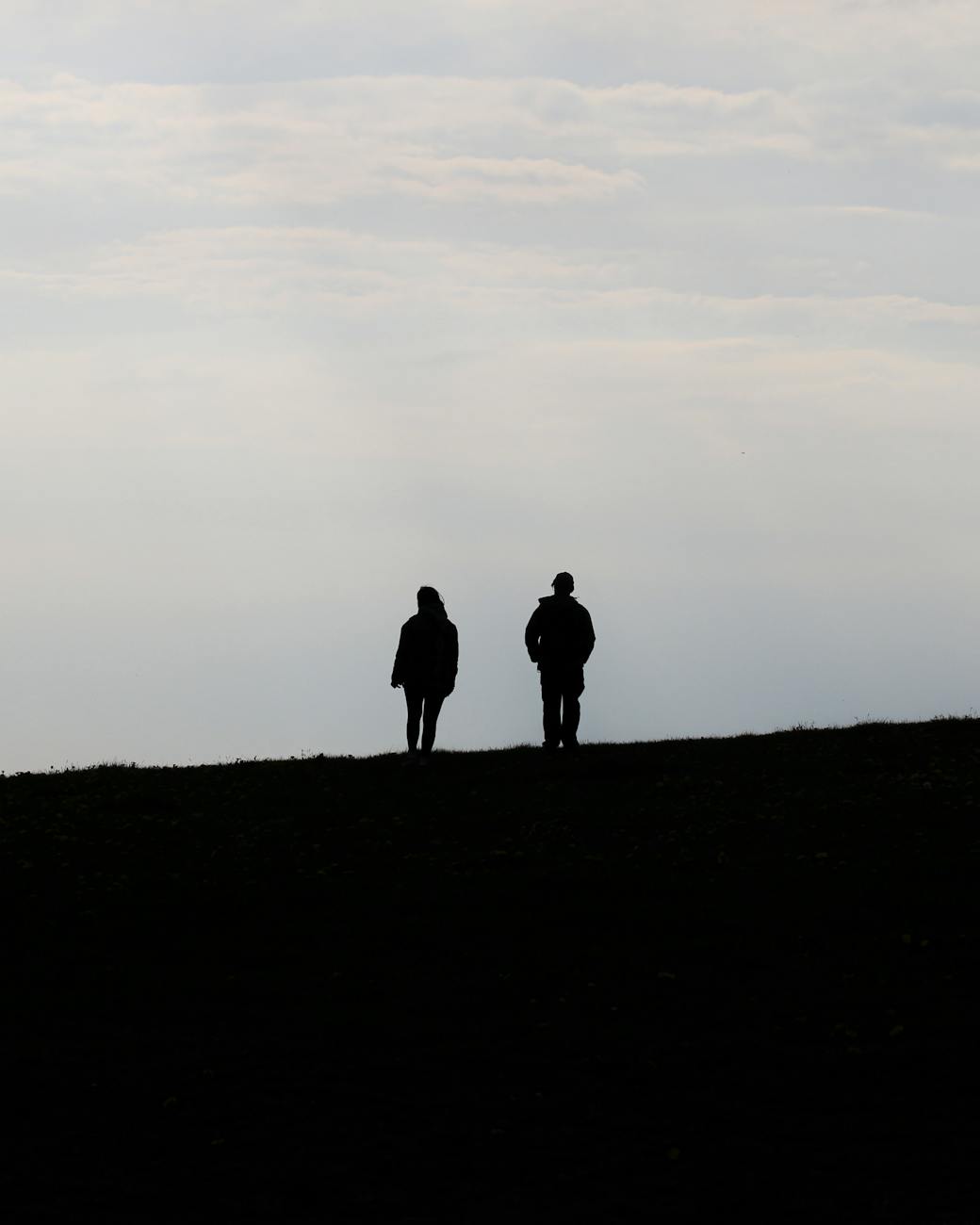
Photo by Boys in Bristol Photography on Pexels.com.

